


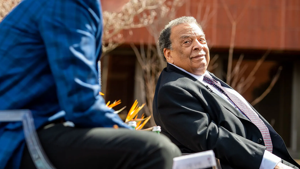
It was the winter of 1962. Demonstrators in Birmingham, Alabama, came to see Dr. Martin Luther King Jr. for his support in organizing a protest in the segregated city where Black people were forced to sit in the back of buses, couldn’t sit at lunch counters with white people, couldn’t even drink out of the same fountains as white people.
Andrew Young was there.
Sixty years later, Young, who went on to become a United Nations ambassador during the Carter administration and later mayor of Atlanta in the 1980s, recalled working with his close friend, Dr. King, during the early stages of the Civil Rights Movement.
During an exclusive interview with The Center Square, Young talked about the pivotal moments in history – a history that he wants to keep alive for today’s generation.
Young said a new Civil Rights curriculum he endorses gives students the facts and figures about what drove the movement and what young activists experienced during that time. He’s backing the curriculum to develop a new generation of citizen leaders, much like the activists Young knew in the 1960s.
“A lot of them were young, 18 to 20 years old,” Young said. “Dr. King and I were fresh out of college.”
Civil Rights: A Global Perspective, powered by McGraw Hill, is a digital curriculum that teaches students Dr. King’s principles of nonviolence, justice, hope, perseverance, among many other values, while examining civil rights movements globally.
The movement’s history remains important to Young, who recalled what King did when he agreed to help the demonstrators in Birmingham.
King told them to write down their grievances, Young said. The list, called the Birmingham Manifesto, detailed the complaints of unequal treatment the black community received from the white community.
Young said King instructed him to go to Birmingham and find someone from the white community to connect with.
“‘We can’t go in there and have a boycott, and we can’t start demonstrations unless we help the white people understand why we’re protesting,"” Dr. King told Young.
Young told The Center Square that he remembered meeting a group of Episcopalians from Alabama at a church conference in Michigan. Young called the church in Birmingham, and a woman he had met at the conference answered the phone. They were able to organize a meeting with Dr. King and the bishop, along with a few white churchmen, Young said.
The meeting allowed both groups to understand each other and what it meant for the Civil Rights Movement to come to Birmingham, Young said.
“There was an actual, honest calm, reasonable discussion just explaining differences,” Young said.
Following that meeting, the diversity, equity and inclusion platform was developed, Young noted as he discussed the Civil Rights: A Global Perspective curriculum.
In an exclusive interview with The Center Square, Dr. Matthew Daniels, one of the authors of the new curriculum, discussed its content and purpose in 2026, a time during which Daniels said civic education has declined.
The curriculum launched the Ambassador Young Fellows Program, which is a weeklong program at Anderson University that brings students and educators from diverse backgrounds to study and apply King’s principles.
“It’s a very diverse mix of people all brought together around this idea of using these principles as an antidote to the forces of division and violence in our day,” Daniels said.
Daniels serves as chair of Law & Human Rights at The Institute for World Politics and is also a professor at Anderson University in South Carolina, where he teaches the curriculum.
The program teaches students not only the history of the social movement but also how lasting change can be achieved through discipline and nonviolent action, Daniels said.
“We are really trying to train up a new generation of citizen leaders,” Dr. Daniels told The Center Square.
Daniels said King’s philosophy remains relevant today.
“You cannot go wrong teaching Dr. King,” Daniels said. “Dr. King’s principles have been validated by history and by social science research. They speak to all people of goodwill. They are not an ideological project of any group or party. They have proven their worth.”
There has been a de-emphasis in today’s society on civic education, Daniels noted, adding that character is the most important object of any educational program.
According to the National Assessment of Educational Progress, only 22% of eighth-grade students nationwide scored at or above the proficient level in civics. The NAEP civics assessment measures students’ understanding of democratic citizenship, government and American constitutional democracy.
“There has been a real failure to educate young people about how to actually achieve social justice,” Daniels said. “Just going out and protesting doesn’t necessarily lead to any results. It might actually lead to bad results.”
“People have forgotten that the Civil Rights Movement was very deliberate, very disciplined, very strategic in everything they did, and that’s one of the reasons they were so effective,” Daniels added.
Young told The Center Square that fairness remains essential to achieving social progress.
“Competition is necessary in a free enterprise system. But to give one group of people an advantage over the other has not worked,” Young said. “The laws of life call for people working together and being fair to each other in order to produce a victory.”
The Center Square contacted several civil rights organizations for comment on the curriculum and the state of civil rights today in America but did not receive a response.