


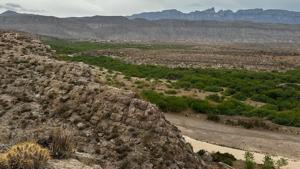
Under outgoing Department of Homeland Security Secretary Kristi Noem, DHS has said it plans to use eminent domain to take Texans’ land if they don’t agree to voluntarily sell it for a border barrier system being built in the Big Bend region of Texas.
After widespread opposition to the plan, DHS has changed versions of proposed wall construction in an online map to indicate construction wouldn’t occur there.
This is not the case. DHS has already awarded more than $3 billion of legally obligated funds for border wall construction in the region. U.S. Customs and Border Protection, which is part of DHS, published a fact sheet describing 175 miles of border barriers to be built in Hudspeth, Jeff Davis and Presidio counties and distributed it to residents. Landowners also received letters threatening eminent domain.
Noem published her plan in the Federal Register, fast tracking construction by waiving “in their entirety” all federal and state statutes, laws, regulations and legal requirements. These include the Endangered Species Act, National Historic Preservation Act, Migratory Bird Treaty Act, Native American Graves Protection Act, Energy Independence and Security Act, Wild and Scenic Rivers Act, and dozens of laws related to historic and environmental preservation, including eliminating protections for the American Eagle.
The proposal includes building border barriers from GPS points 31.037623, 105.579877 in Hudspeth County, extending south and east to GPS points 29.325866, 104.046466 in Big Bend National Park near Santa Elena Canyon, according to the Federal Register. The canyon is 1,500 feet high.
Construction includes building a 30-foot-high wall with six-inch square diameter steel bollards spaced roughly four inches apart with anti-climb features, as is the case with other Trump-era border wall construction. The border wall system includes access roads, drainage gates, erosion and drainage control, fiber option and power cables, lighting and lightning poles, surveillance cameras and CTV, shelter stations, among other structures.
CBP is seeking input from the public through April 6 on the project’s potential impacts on the environment, cultural resources and commerce. Comments may be emailed to [email protected] with “Big Bend Border Barrier System” in the subject line, or by calling 833-412-2056.
CBP sent a letter to landowners notifying them of the federal government’s need to enter their property to either construct barriers on it or go through it to construct barriers. The letter was obtained by The Center Square.
The landowners were given three options.
Option A proposes property owners enter into a right of entry for construction agreement (ROE-C) allowing federal access to their property to complete surveys, appraisals and begin and complete border barrier construction. A separate contract would be negotiated to purchase property to construct the barrier. Option B proposes a landowner sell an easement to the federal government outright.
The notice states DHS’s preferred option is Option A, which would allow construction to be competed “as quickly as possible” and landowners would be paid “a fair market value.” If landowners agree, they would receive a one-time lump sum in addition to the fair market value. If it’s later determined that DHS doesn’t need to acquire the property, they wouldn’t have to repay the lump sum, the letter states.
“The ROE-C does not grant CBP permanent access to your property, nor does it include the permanent transfer of any real property interest to CBP; it is just an agreement to provide CBP temporary access to the property so that it may conduct activities related to border barrier construction,” the letter states. “Your land is still your land, you would just be giving CBP permission to enter onto your land and begin construction on border barrier infrastructure if necessary. Should CBP determine that it is a permanent need for any portion of your property, CBP will then need to separately acquire those property rights from you as required by the uniform relocation act,” the letter states.
If the landowners aren’t open to the first two options, Option C would take effect: DHS would initiate an imminent domain condemnation process to take their property.
“It is always CBP’s preference to obtain the necessary real estate for border barrier projects through voluntary agreements. However please be advised that if we are unable to reach a voluntary agreement through negotiation within a reasonable time, CBP [and DHS] may proceed to refer the matter to DOJ to acquire any necessary property interest through the exercise of eminent domain common ordinance with the Declaration of Taking Act,” the letter states.
Under Noem, DHS already awarded more than $3 billion in border wall contracts for the Big Bend region. It awarded $1.2 billion to Tempe, Arizona-based Fisher Sand & Gravel to build a vertical barrier for the BBT-2 Border Barrier Construction Project.
It awarded two contracts to Bozeman, Montana-based Barnard Construction Company. One is for $960 million to construct the BBT-3 Border Barrier Construction Project in Hudspeth, Jeff Davis and Presidio counties. The stated place of performance is Terlingua with a start date of March 5 and potential end date of May 26, 2027.
Another is for more than $1 billion for border barrier construction in Hudspeth County. The stated place of performance is Sierra Blanca, with a project start date of March 5 and potential end date of August 31, 2028.