


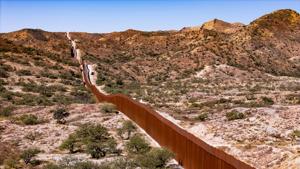
A 26-year Border Patrol veteran, U.S. Air Force veteran and now Terrell County Sheriff Thad Cleveland says what law enforcement needs in the Big Bend region of Texas is a virtual wall and countersurveillance technology, not a physical border wall.
He is joining many in Texas law enforcement, judges, ranchers, business owners, residents and others in five west Texas counties who oppose a Department of Homeland Security plan to build a border wall in the region, The Center Square reported.
A Big Bend region native involved in Texas’ border security mission, Operation Lone Star, Cleveland says border security “solutions already exist. They’re just needed on a larger scale.”
“Border security isn’t a one-size-fits-all approach and if policy makers in Washington, D.C., understood the purpose of a physical wall, the last place they’d build one is in the Big Bend region,” he told The Center Square in an exclusive interview.
One solution is to deploy Anduril Autonomous Surveillance Towers across the southwest border. “They have already helped reshape border security – without building a physical wall,” he said.
The solar-powered towers “act as a virtual fence along remote stretches of the border,” he said. Using radar, optical and thermal cameras and AI software, they are designed to automatically detect, classify and track people or vehicles miles away 24/7, 365 days a year.
The towers are used in a network to create continuous coverage in a wide region, creating a virtual fence or wall, he said. The system sends smart alerts with real-time imagery, enabling agents to respond to an exact location at an exact time. In Sanderson, Texas, where he lives, “they are reliable and effective. Using them, we’ve seen less false alarms and faster response times.”
The towers were first deployed under the first Trump administration in 2019 in the San Diego, California, region. By September 2024, ASTs were providing coverage for roughly 30% of the southwest border with more than 300 towers operational.
“In places like the Big Bend region, where physical barriers are impractical, this technology enables a virtual wall built on sensors, software, and rapid response instead of concrete and steel,” Cleveland said.
The region includes “steep mountains, deep canyons, vast desert expanses, and the winding Rio Grande River [that] already create a formidable natural barrier. Anyone who has worked this ground understands that nature itself significantly restricts movement and large-scale crossings,” he said. “Building a wall here would destroy a natural environment that has existed long before Texas was Texas or the United States was the United States.”
Another solution is to deploy drones, “specifically platforms like the MQ-9 Predator B, which can cover rugged terrain faster than vehicles, constantly monitor vast areas and guide agents to exactly where they need to go at the right time,” he said. They also help reduce strain on Big Bend Border Patrol agents who are tasked with covering the largest square mileage of any sector in the country with the least number of agents.
“We need dedicated predator drones across the border 24/7 and we don’t have it,” he said.
He also said a physical border wall “was never the plan for the Big Bend region of any administration” until former Homeland Security Secretary Kristi Noem, who was recently fired.
“Historically, a border wall in urban-to-urban environments stops people from crossing by closing regional and reactionary gaps. There is only one urban-to-urban area in Presidio where a wall might work but for the rest of the region it’s not practical,” he said.
The Big Bend region is very remote. There is limited infrastructure on both sides of the border in the U.S. and Mexico, few roadways and little-to-no transportation capacity to support large-scale movement. While the Big Bend region saw a record number of illegal border crossers during the Biden administration, they weren’t comparable to the thousands who arrived at a time in urban areas like El Paso or the Rio Grande Valley.
“Physical barriers have their place in border security,” Cleveland said. “But in the Big Bend region, natural obstacles already exist and illegal crossing patterns simply don’t justify heavy infrastructure. What we really need is enhanced surveillance, targeted patrol and flexibility and support for law enforcement.”
Perhaps the most essential piece to border security, is local and state law enforcement working together toward one common goal, he said. In Texas, law enforcement had the support of former Gov. Rick Perry and have the support of Gov. Greg Abbott and the Texas legislature, he said. “Their support is critical. Operation Lone Star funds enable us to continue border security efforts,” he said, which include targeting terroristic threats.
“We in the Big Bend region want border security and we have a solution,” he said. “Residents here shouldn’t have to pay the price for Noem’s mismanagement and questionable government contracts. This is our home. We stand ready to defend it. And we don’t need a border wall to do it.”