


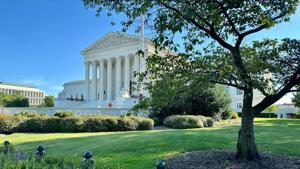
The U.S. Supreme Court will hear arguments on Tuesday in a case to determine whether presidential administrations can issue financial damages against immigrant employers.
Justices on the high court will hear arguments in U.S. Department of Labor v. Sun Valley Orchards, a case centered around a New Jersey farm that was found liable for more than $550,0000 in damages. The Labor Department conducted an investigation against the family-owned farm for not providing adequate housing and work conditions for H-2A farmworkers.
The H-2A visa program allows migrant farm workers to temporarily reside in the United States while employed in the country. Farms that recruit workers are required to comply with regulations that ensure U.S. citizens are not disadvantaged in the recruitment process.
Lawyers for the farm argued that officials in the executive branch should not be allowed to assess damages against family-owned farms. Sun Valley Orchards went out of business following the assessed damages.
“There is no precedent or history supporting agency adjudication of such employment-related issues,” lawyers for the farm wrote. “The government’s contrary argument would vastly expand the public rights exception for immigration-related claims to encompass myriad issues involving temporary workers.”
Lawyers for the government disagreed with Sun Valley Orchards. The lawyers argued that Congress has given authority to administrative agencies like the Department of Labor to adjudicate worker issues.
“Administrative adjudications provide an efficient mechanism for ensuring that employers who participate in that vast program comply with those terms and conditions,” the lawyers for the government wrote in a brief to the court.
Alex MacDonald, co-chair of the law firm Littler Mendelson’s Workplace Policy Institute, said the dispute represents a unique case where the Trump administration is defending a policy that argues for more government regulation, likely because it falls into the category of immigration policy.
Justices on the high court will decide whether the federal courts are equipped to step in with workplace disputes or if administrative bureaucracy has the say. MacDonald said the court’s opinion on administrative authority will have broad influence for migrant worker disputes moving forward.
“Depending on the way the court decides this case, yeah, it could have implications for those other [migrant worker] statutes,” MacDonald said.
The case balances a unique blend of public and private rights, MacDonald said. He said the right to equal housing and fair employment would often be settled in a courtroom under Article III of the Constitution. However, the government has leeway to handle any of these issues when immigration is involved because it poses a national security issue.
Thomas Berry, director of the Cato Institute’s Center for Constitutional Studies, said migrant worker programs are discretionary and provide for different legal processes.
“If you participate in a discretionary privilege program, you also do not get an article 3 court right,” Berry said.
MacDonald said legal precedent provides for a gray area in adjudication of migrant labor disputes. He predicted justices will deal with definitions of the word “impose” in federal laws that give executive agencies the power to handle migrant worker disputes.
“We’re looking at one word in a statute that just says ‘impose,"” MacDonald said about the high court’s potential thought process. “That’s not obvious to us that that should be an administrative hearing with what we’ve said about cases that should go to article three courts.”
Berry raised the possibility that a high court ruling in favor of Sun Valley Orchards could allow for deportation proceedings to be handled differently, a critical issue for the Trump administration.
However, MacDonald said the statutes for deportation proceedings provide requirements for a specific hearing to take place, unlike when adjudicating migrant worker disputes.
“[A] removal proceeding is not about a dispute between an employer and a worker involving employment law,” he said. “So, there’s not that same private rights element to it.”
However, lower courts could alter other work visa proceedings with similar statutory language at issue. This could mark a significant shift for the Trump administration while it attempts to restrict foreign workers in other visa programs.
“A lot of the statutes, at least the ones I’m familiar with, are similarly unclear about the department’s authority or how it is supposed to go about enforcing the relevant statutes,” MacDonald said.
Justices on the high court will hear arguments in the case on Tuesday and are expected to issue a decision by June 2027.