


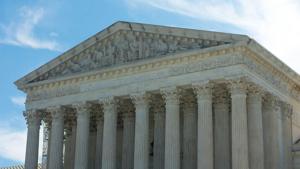
The U.S. Supreme Court agreed on Monday to hear a case challenging race-based admissions policies in Maryland schools.
The high court agreed to hear Association for Education Fairness v. Montgomery County Board of Education, a case focused on a group of parents in Montgomery County who say four magnet middle schools discriminated on the basis of race in admissions policies.
The parents say Asian American students were underrepresented after the schools changed certain admissions policies to increase enrollment for Black and Hispanic students in 2016. In 2020, the school district opened its admissions policies to a lottery for students at or above the 85th percentile in local testing.
Parents still challenged the lottery system, saying Asian American students were disadvantaged since they came from high-performing, low-poverty elementary schools and could not access the lottery.
The parent groups say the outcomes of the case continued to be racially discriminatory, even though the lottery was not so on its face.
“Under the applicant pool benchmark, the government can set specific racial targets, hit them, and avoid even an inquiry into discriminatory intent so long as it employs a facially-neutral proxy instead of an explicit racial classification,” lawyers for the parents wrote in a brief to the high court.
Lawyers for the Montgomery County Board of Education in Maryland say the lottery system could not realistically be classified as discriminatory on the basis of race.
“It is difficult to even conceptualize how a lottery-based admissions policy – adopted in response to an unforeseeable global pandemic – could intentionally discriminate on the basis of race,” lawyers for the county board of education wrote.
Justices on the high court agreed to hear the case to resolve one question presented: whether challenging seemingly neutral admissions policies on the basis of race must establish that a certain racial group suffered harm.
Lawyers for the parents pointed to other cases the high court has dismissed based on similar admissions challenges.
“The criteria used to admit students to competitive public schools are of substantial importance to many families, particularly in the nation’s largest school districts,” lawyers for the parents wrote. “These schools provide exceptional educational opportunities to students who might otherwise lack access to comparable academic programs.”
Justices on the high court will likely hear the case in early 2027. The admissions case will be one of the most significant the court has granted since Students for Fair Admissions Inc., v. President and Fellows of Harvard College, a case where the high court ruled against racially discriminatory admissions practices at Harvard.
Justices on the court will issue a decision in the case by July 2027.