


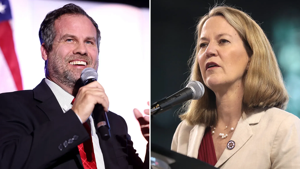
Senate President Warren Petersen and U.S. Rep. Andy Biggs are vying to give Republicans back control of Arizona’s executive branch.
During the Nov. 3 general election, Petersen, R-Gilbert, will face Democratic Attorney General Kris Mayes in the attorney general’s race, while Biggs, R-Gilbert, will challenge Democratic Gov. Katie Hobbs in Arizona’s gubernatorial race. Early voting is already underway.
Between 2011 and 2023, Arizona had a Republican governor and attorney general, but that changed when state residents elected Hobbs and Mayes. That turned Arizona into a state where Democrats, for the most part, control the executive branch. Republicans control both houses of the Legislature, but lack enough seats to override Mayes’ vetoes.
Attorney general’s race
Petersen, who is term-limited in the Senate, said if elected attorney general, his top priorities would be “fighting crime, defending the laws of the Constitution and rooting out fraud, waste and corruption.”
Petersen told The Center Square that he would “double the number of criminal investigators and criminal prosecutors,” adding that he could do so within the office’s current budget.
According to Mayes, her priorities if reelected to a second term are “keeping Arizonans safe, protecting families from drug smugglers and scams [and] holding powerful corporations accountable.”
“We’ve seized 27 million fentanyl pills, cracked down on massive fraud schemes, and taken on corporations accused of driving up costs, and I’m ready to build on that work in a second term,” Mayes told The Center Square via email.
Petersen said he would defend Arizona’s “common-sense laws,” unlike Mayes. He highlighted how Mayes did not defend Arizona’s Save Women’s Sports Act, which prevented biological males from competing in women’s sports. Petersen intervened in court to defend the law.
Petersen previously told The Center Square that, as state Senate president, he was managing “over 110 cases or amicus briefs.”
Mayes accused Petersen of having “spent his career putting politics first,” while she has “focused on getting results for Arizona.”
“I’m the attorney general for all Arizonans, and I’ll keep fighting for Arizona families, not special interests,” she explained.
As attorney general, Petersen said he would have the state enter into a 287 (g) immigration enforcement program with the federal government. He added he would encourage local law enforcement agencies to join the program.
The 287(g) program lets state and local law enforcement agencies enter agreements with U.S. Immigration and Customs Enforcement to perform limited immigration enforcement duties under federal supervision.
The Center Square asked Mayes about supporting Arizona law enforcement agencies in participating in the 287(g) program with ICE. She did not answer the question directly, but instead said she has “called for more DEA [the U.S. Drug Enforcement Administration] agents on the ground in Arizona and worked with federal law enforcement to prosecute the cartels and get dangerous drugs off our streets.”
Mayes also highlighted her legal defense of Arizona’s Secure the Border Act, which is a 2024 voter-approved proposition that allows the state more legal options to defend its border against illegal immigrants. The proposition is currently being challenged in court. Petersen also intervened to defend it.
In September, Mayes ordered a review of Arizona’s use of Flock cameras and other automatic license plate readers.
“Law enforcement needs the tools to solve crimes, but we also have a responsibility to protect people’s privacy and constitutional rights,” Mayes said. “We can keep our communities safe while protecting Arizonans’ rights, and we need clear statewide standards to do both.”
If elected, Petersen said his office would work with the Legislature to ensure Arizona’s privacy is not “being violated” and that data can be accessed only with a warrant.
He said Flock is “not trustworthy,” noting it is not a “company that government should do business with.”
According to the latest records from the Arizona Secretary of State’s Office, Mayes has a cash-on-hand advantage over Petersen: $1.6 million to $259,220.
Mayes has received $186,500 from political committees. Mayes received $5,000 from the Environmental Defense Action Fund Political Action Committee, associated with the Environmental Defense Fund, a left-leaning nonprofit environmental group, and $10,000 from the Arizona Education Association’s PAC.
Petersen has received $143,700 from political committees, including $11,000 in contributions from the Homebuilders Association of Central AZ and $5,500 from the American Federation for Children Action Fund Arizona PAC, which is associated with the national AFC, a nonprofit that promotes school choice.
Mike Noble, CEO of Noble Predictive Insights, told The Center Square that polling shows the attorney general’s race has tightened but still leans in Mayes’ favor.
Gubernatorial raceIn the governor’s race, Biggs recently told The Center Square’s daily podcast “The States” that Arizona should eliminate its state income tax. The state currently has a flat 2.5% income tax.
The Center Square tried to contact Biggs and Hobbs for this article, but they didn’t respond before publication time.
Biggs told “The States” host Greg Bishop that Arizona has “gone from being one of the most affordable states to one of the least affordable states.”
Biggs’ campaign website says he would reduce red tape and work with local governments to reduce “permitting barriers” to lower home costs in Arizona.
To support job growth, Biggs’ campaign website says he backs eliminating regulations and red tape that prevent job creation in Arizona.
Regarding border security, Biggs told The Center Square’s podcast that Hobbs is an “open borders advocate,” citing Hobbs’ decision to repeal border barrier initiatives and to defund Arizona’s border security strike task force.
Biggs supports reintroducing the border security strike task force and encouraging state and local law enforcement to join the 287 (g) program, according to his campaign website.
In 2025, Hobbs vetoed a bill that would have required local law enforcement agencies to enter into a 287(g) agreement with ICE.
Hobbs’ campaign website says the governor is fighting to lower prices and return money to Arizonans, highlighting the budget she signed for Fiscal Year 2027, which eliminated taxes on tips and overtime, increased the child tax credit and raised the standard deduction.
In the FY 2026 and FY 2027 budgets, Hobbs tried to set a household income cap for the state’s school choice program, the Empowerment Scholarship Account. Neither finalized budget included one.
She has advocated for more oversight of the program.
According to Biggs’ campaign website, he supports protecting the state’s ESA program.
The latest records from the Arizona Secretary of State’s Office show Biggs has a cash-on-hand advantage over Katie Hobbs: $1.2 million to $175,800.
Biggs has only received $36,150 from political committees during his campaign, with most of it coming in 2025. The Freedom Club PAC donated $11,000 to Biggs’ campaign last year.
Freedom Club PAC is associated with the Arizona Free Enterprise Club, a conservative nonprofit advocacy group.
The latest numbers show Hobbs taking $325,873 from political committees. Throughout her campaign, she has received $11,000 in donations from several PACs, including the Arizona Education Association, the state’s largest teachers union, and the Salt River Project. She also received a $5,500 donation from a Microsoft-aligned PAC.
Noble said Hobbs reached her “high point in the race” this summer because she had “massively” outspent Biggs. Now, Noble said Biggs’ proponents have spent large sums, so the race has tightened. However, he noted the race still favors Hobbs.
Other executive branch racesIn another race, a Republican is attempting to unseat a Democrat for state secretary of state. State Rep. Alex Kolodin, R-Fountain Hills, is facing off against Secretary of State Adrian Fontes.Fontes advocates cleaning up the state’s voter rolls and implementing stronger voter identification laws in Arizona.He is the sponsor of Proposition 144, a Nov. 3 measure that seeks to prevent noncitizens from voting, mandate government-issued identification to vote and prevent foreign nationals from contributing to campaigns in a way that could impact an Arizona election.Fontes has been the secretary of state since 2023. During his term, he implemented a program that lets voters check their ballot status, declined to hand over unredacted statewide voter registration lists to the Trump administration and created new funding sources for county election recorders to maintain accurate voter rolls.For endorsements, Fontes has received support from Equality Arizona, the AEA, the VoteVets Action Fund and former U.S. Rep. Adam Kinzinger, R-Illinois. Kinzinger was one of two Republicans, along with former U.S. Rep. Liz Cheney of Wyoming, who served on the House January 6th Select Committee investigating the 2021 riot at the Capitol.President Donald Trump, Turning Point USA, the Maricopa County Arizona Fraternal Order of Police and numerous state Republican lawmakers have endorsed Kolodin.Noble, CEO of Noble Predictive Insights, said the secretary of state race has narrowed, but Fontes still leads.In Arizona’s state treasurer race, Democrat Nick Mansour and Republican Elijah Norton are facing each other to replace Republican Kimberly Yee, who is running for Arizona superintendent of public instruction.
Mansour, the former CEO of Arizona College of Nursing, is running to “over [Arizona’s] taxpayer dollars, eliminate waste, invest responsibly, and return money to hardworking Arizonans,” according to his campaign website.Norton, a former state GOP treasurer and entrepreneur, is attempting to bring his business skills to “government where he will serve as a watchdog taxpayer dollars, eliminate waste, divest from woke and leftist causes, and return money to the people, his campaign website notes.