


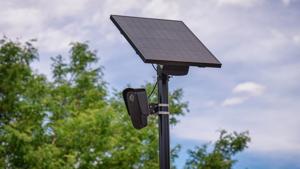
With Americans across the country rebelling against thousands of AI enhanced surveillance cameras infiltrating their cities, a bipartisan group of lawmakers has proposed a bill prohibiting the funding of those cameras with taxpayer money.
U.S. Reps. Thomas Massie, R-Ky., and Eric Burlison, R-Mo., are cosponsoring the FLOCK OFF Act with bipartisan support. It targets the controversial cameras, such as Flock Safety cameras, that use Automated License Plate Recognition (ALPR) or biometric data collection technology.
“The federal government shouldn’t provide ‘security’ grants to cities and police departments that have gone beyond the pale and turned their communities into a version of 1984,” Massie said.
“The Flock-Off Act withholds federal money from municipalities and police departments that deploy Flock cameras to surveil law-abiding citizens. Federal taxpayers should not be forced to fund the surveillance state.”
The legislation prohibits state and local governments, municipalities, police departments, and other entities receiving federal funds from “directly or indirectly” using that money to “[p]urchase, lease, acquire, install, deploy, maintain, repair, replace, upgrade, or operate a covered camera system or any associated component.”
It also forbids those government agencies from renewing any current subscription, contract or agreement involving the use of those cameras or the data the cameras collect. Those parties additionally cannot reimburse or subsidize a non-federally funded party for the installation or maintenance of such technology.
“Technology may change, but our constitutional rights do not,” Burlison said. “The Fourth Amendment protects Americans from unreasonable searches, and advances in surveillance technology should not come at the expense of our privacy and liberty. The federal government should not use taxpayer dollars to build a surveillance state that tracks law-abiding Americans. Our rights are unalienable, and Congress has a responsibility to protect them.”
The bill stipulates that both government agencies and the surveillance technology providers currently receiving taxpayer funds remove and cease operating the surveillance technology within 180 days of the bill’s enactment.
However, the bill carves out an exception for U.S. Border Patrol as long as the cameras are situated within a mile of the country’s northern or southern border and are “used primarily for border security”-related criminal activity. It also allows the use of the cameras for toll collection.
As of September 2026, at least 138,000 cameras with ALPR technology have been mapped across the U.S. by independent organizations like Finding Flock. Flock Safety, Axon Enterprise, and Motorola Solutions are just a few of the companies in the surveillance industry.
The recent spread of these cameras raises multiple privacy and safety concerns, according to critics. There are dozens of documented cases of individuals utilizing the cameras to harass and stalk innocent individuals.
More importantly, the federal government can buy the data collected by these cameras, outsourcing what would normally constitute unconstitutional surveillance to private companies.
Flock Safety alone has spent $2 million in federal and state lobbying efforts since 2025, according to a recent analysis by OpenSecrets.