

Voter concern about inflation and prices has surged to its highest level since The Center Square began tracking the issue.
According to The Center Square Voters’ Voice Poll, conducted by Noble Predictive Insights, a nonpartisan public opinion polling firm, 43% of registered voters included inflation or price increases among their top three concerns in June, up from 37% in March.
The shift comes as the conflict with Iran has disrupted global oil markets and driven up gas and fuel prices. The Strait of Hormuz, a critical oil shipping route, closed on Feb. 28, 2026, when Operation Epic Fury began, according to the U.S. Energy Information Administration.
U.S. regular gasoline averaged $2.94 per gallon that week, according to EIA data. As of June 11, the national average had climbed to $4.13 per gallon, according to AAA.
“Cost of living just still dominates,” said Mike Noble, founder of Noble Predictive Insights, which conducted the poll. “Inflation is still the top issue.”
Inflation and price increases topped the list of voter concerns, with 20% ranking it as their top issue, up from 15% in March. Government corruption (27%), economy and jobs (27%), healthcare (26%) and illegal immigration (19%) rounded out the top five concerns among registered voters.
Throughout the 2024 presidential campaign, then-candidate Donald Trump repeatedly promised to bring prices down after taking office.
“When I win, I will immediately bring prices down,” he said at an Aug. 15, 2024 press conference in Bedminster, N.J.
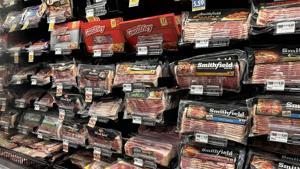
Because of the rise in gas costs, other prices continue to climb. Ground beef has risen 22%, from $5.55 to $6.75 per pound since January 2025, while ground coffee has jumped 35%, from $7.02 to $9.51 per pound, according to Bureau of Labor Statistics average price data. Overall consumer prices rose 4.2% over the past year, with energy costs up 23.5%, according to the U.S. Bureau of Labor Statistics May 2026 Consumer Price Index report.
Karlyn Bowman, a distinguished senior fellow emeritus at the American Enterprise Institute, a Washington-based public policy research organization where Bowman has tracked public opinion trends for decades, said the findings align with broader national trends.
“When inflation is included as a category, it is the top problem in almost every poll these days and concern about it has been rising,” Bowman told The Center Square.
The inflation anxiety is playing out against a backdrop of growing pessimism. Sixty percent of voters say the country is headed in the wrong direction, up from 53% in March, while the generic congressional ballot has shifted from a one-point Democratic advantage to a six-point Democratic advantage over the same period.
Among true independents – those who declined to lean toward either major party, whose subsample carries a larger margin of error than the overall poll – Trump’s net approval is -51 points and nearly seven in 10 say the country is on the wrong track.
“Republicans got a problem on their hands if these economic pain points continue or get worse,” Noble told The Center Square.
True independents are even more pessimistic about the electoral landscape. Nearly half remain uncommitted on the congressional ballot despite their deep dissatisfaction with the current political environment.
“If they’re feeling all this economic pain, I don’t think they’re going to stick with them when it comes time that they have to make a decision,” Noble told The Center Square.
Kyle Kondik, managing editor of Sabato’s Crystal Ball at the University of Virginia Center for Politics, said the Iran conflict has compounded existing Republican vulnerabilities.
“The fallout from the war in Iran, namely on gas prices, has very likely contributed to the Republicans’ preexisting political problems,” Kondik told The Center Square. “I think that helps explain a lot of what you found.”
On true independents, Kondik offered a cautionary note.
“Independents are not very keyed into elections, and a great deal of them may not even vote,” he said. “So it doesn’t necessarily surprise me that they are both very upset but also somewhat disengaged from the vote choice. But these are people Republicans should likely be worried about if they do in fact vote.”
Alan Abramowitz, a political scientist at Emory University in Atlanta who specializes in elections and voting behavior, said the poll results are consistent with a political environment that historically produces wave elections, in which one party makes large, broad gains across many races.
“At this stage in 2018, the last time we had a midterm wave election, Democrats picked up 40 seats in the House, and going into the 2018 midterm elections, the generic ballot had Democrats at about plus seven, plus eight – similar to where it is now,” Abramowitz told The Center Square.
“It’s shaping up to be a big wave. Democrats only need to pick up three seats,” he said.
Republicans hold a 218-212 majority in the House, according to the House Press Gallery.
The Republican National Committee did not respond to requests for comment.
A Democratic House majority would control the chamber’s floor agenda, all committee and subcommittee chairmanships, and the origination of revenue legislation – giving Democrats influence over the trillions of dollars in federal spending, according to the Congressional Research Service.
Bowman noted the dissatisfaction is bipartisan.
“Americans aren’t happy with the administration, or with the Democrats and Republicans in Congress,” Bowman told The Center Square.
White House spokesman Kush Desai said the administration expects prices to fall once the Iran conflict is resolved.
“President Trump has always been clear about the fact that oil and gas prices – and thus overall inflation – will rapidly drop as soon as the Iran situation is resolved,” he told The Center Square. “Prior to the start of Operation Epic Fury, American workers had recovered almost half of the real wage losses they experienced under Joe Biden thanks to this Administration’s commonsense agenda of deregulation, tax cuts, and energy abundance – an agenda that the Administration continues to implement to deliver more economic relief for the American people.”
However, Bureau of Labor Statistics data shows real average hourly earnings stood at $11.24 in May 2026 – unchanged from when Trump took office in January 2025 and below the $11.43 recorded when Biden took office in January 2021.
The Center Square Voters’ Voice Poll was conducted by Noble Predictive Insights, a nonpartisan public opinion polling firm, from June 1-4, 2026 and surveyed registered voters nationally via opt-in online panel and text-to-web cell phone messages. The sample included 2,585 respondents comprised of 915 Republicans, 1,013 Democrats, and 297 True Independents. The margin of error is +/- 1.93%. The margin of error for the 297-person True Independents subsample is larger than the overall survey margin of error.