


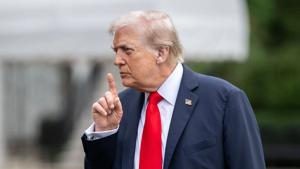
President Donald Trump says he’ll declare the Strait of Hormuz a U.S. territory, but no federal agency has said what controlling the key oil chokepoint would cost taxpayers.
“After we finish defeating Iran, which is being very badly defeated, pretty soon I’ll be declaring the Hormuz Strait a territory of the United States,” Trump said Friday at an event on Long Island.
Asked to elaborate Monday in the Oval Office, Trump did not detail a legal basis or cost.
“I just think it’s a great idea,” he said. “We control it with the blockade. … I like the idea of declaring it a territory.”
The strait is at least the fifth foreign territory Trump has proposed bringing under U.S. control, after Greenland, the Panama Canal, Canada and the Chagos Islands. The strait isn’t for sale: it runs through Iranian and Omani territorial waters, and neither country is offering to hand it over. What it would come with is the open-ended cost of a military presence to control it.
A Congressional Research Service report updated Aug. 7 lays out several possible scenarios for U.S. involvement in the strait, including establishing “its own formal administration” of the waterway. The CRS report puts no dollar figure on any of them, noting only that such a commitment “could require long-term investments of U.S. military, diplomatic, and other resources.”
The Center Square asked U.S. Central Command, the Department of War and the White House what controlling the strait would cost. None provided a figure. The command referred the question to the Department of War, which pointed to Secretary of War Pete Hegseth’s congressional testimony from May. In that testimony, Hegseth did not give a cost for the blockade or for controlling the strait.
In practice, the Trump administration has sought to control shipping through the strait with a U.S. naval blockade. Central Command said on X that as of Monday, its forces had “redirected 64 commercial vessels, disabled 3, and boarded 2 to ensure compliance,” part of an operation the command calls a “steel wall” against Iran. The blockade has been imposed, lifted and reimposed since April as fighting and negotiations have flared and stalled.
What the government has quantified is the cost to Iran. The Pentagon estimated in May that the blockade had cost Iran about $4.8 billion in lost oil revenue, and officials have cited figures of roughly $435 million a day. No comparable figure has been offered for what the operation costs U.S. taxpayers.
Mark Cancian, a retired Marine colonel and senior adviser at the Center for Strategic and International Studies, has said the Navy is poorly equipped for the mission. In a July analysis, he wrote that the service spent “tens of billions” on carriers and destroyers while neglecting the mine-clearing and convoy-escort capabilities a strait fight actually requires.
Iran rejects the idea outright. Its judiciary chief, Gholamhossein Mohseni-Ejei, called Trump’s claim a product of “delusions” and said Iran “is the owner and ruler” of the waterway, according to the state news agency IRNA. Iran and Oman, which share the strait’s territorial waters, have been negotiating its future without the United States.
Those talks drew a threat from Trump. In a Fox News interview Monday, he said that “if Oman gets in the way, we’ll bomb the s— out of them.” Asked about it later in the Oval Office, he said Oman had not “behaved very well” but that the U.S. would “handle them very easily.” Oman, a longtime U.S. partner and frequent intermediary with Iran, had not responded to a request for comment as of Monday evening.
In March, Trump directed the U.S. International Development Finance Corporation to provide political-risk insurance for commercial shipping in the Gulf. The agency committed $20 billion in coverage, and by April, the facility had grown to $40 billion, with private insurers led by Chubb. Earlier reporting indicated the facility went largely unused. A DFC spokesperson said the agency was preparing a comment but did not provide one by the deadline.
The territory claim is the latest in a shifting set of proposals for extracting money from the strait. In June, Trump floated charging for passage, describing the U.S. as a “Guardian Angel” owed reimbursement “for services rendered.” By mid-July, he had dropped the fee idea in favor of having Gulf states make what he called “massive” investments in the U.S.
Iran, meanwhile, has pursued its own version. Tehran established a “Persian Gulf Strait Authority” in May to charge vessels for passage, a body the U.S. Treasury sanctioned that same month, and has estimated that charging for security and other services could bring in about $40 billion a year, according to the CRS report.
The question of who pays to keep the strait open is not new. During the 1980s “Tanker War,” the U.S. Navy escorted oil tankers through the Gulf and fought Iranian forces in the largest naval surface battle since World War II. Some members of Congress, then as now, pressed for allies who relied on the strait to help cover the cost. Forty years later, the cost of the current operation remains unstated.