


Arguing that the U.S. is “underinvesting in discovery,” U.S. Sen. Dave McCormick, R-Pa., is calling for changes to the National Institutes of Health, or NIH, which include increased investments from the federal government.
“Rather than cut NIH by nearly 40 percent, as the Office of Management and Budget proposed last year, we should double its $48 billion budget within five years,” McCormick wrote in a Washington Post op-ed published on Wednesday. “These are big numbers, but if they yield discoveries that trim the nation’s $5.3 trillion health bill by just 1 percent, they will more than pay for themselves.”
McCormick is an ally of President Donald Trump but has on multiple occasions criticized federal proposals to cut NIH funding.
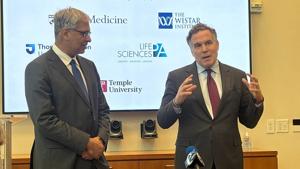
During a visit to Penn Medicine at the University of Pennsylvania in late March, alongside NIH Director Dr. Jay Bhattacharya, he touted the agency’s impact on the Keystone State and again called for increased support.
“It’s a huge benefit to Pennsylvania and benefit to the country that Pennsylvania is a big recipient of NIH funding,” McCormick said during that visit.
According to the senator’s office in late March, Pennsylvania is the fourth largest recipient of NIH funding in the nation, with the state receiving $2.27 billion in federal research funding in FY2025.
“Nationally, every NIH dollar also generates roughly $2.50 in economic activity,” McCormick wrote in Wednesday’s op-ed. “In Pennsylvania, NIH research sustains over 21,000 jobs and generates an impact of more than $5 billion annually, and AI will accelerate breakthroughs.”
The federal government spends $7 trillion a year, McCormick notes, while adding that less than 1% goes to NIH research.
“That sliver delivers outsize returns,” McCormick wrote.
McCormick cites the institute’s work on cutting Type 2 diabetes risk, eye disease research that saves health care costs, reducing legal blindness, and CAR-T cell therapy, pioneered at Penn, which reengineers patients’ T cells to attack cancer, producing decade-long remissions and replacing years of costly treatments.
He also believes that America’s global leadership in this space is “slipping,” noting that China has boosted research and development spending from 36% of the U.S. level in 2008 to parity in 2024. Beijing, McCormick wrote, now accounts for about one-third of the world’s clinical-stage drugs.
“Federal R&D fell from 1.86 percent of gross domestic product in 1964 to 0.63 percent in 2024,” McCormick wrote. “Since 2003, the NIH budget has shrunk by more than 10%, adjusted for inflation.”
“We have also let politics intrude on science. The NIH under the Biden administration gave CHOP $155,000 to develop training on “structural racism” and “intersectional microaggressions.” Such initiatives abused taxpayer money and undermined trust,” he continued.
Although McCormick is calling for increased NIH funding, he also lauded the White House for calling for a “new golden age of American science.”
“Conservatives should recognize that basic research, like national security, is a public good that private capital rarely funds,” McCormick wrote. “Businesses excel at turning discoveries into products and jobs, but foundational science pays off too slowly and uncertainly.”
“Government fills the gap, funding the long-term, high-risk work that businesses turn into breakthroughs with stunning payoffs for society,” he added.
The second proposal McCormick cites in his op-ed is the need to “prioritize merit-based science.”
“The Trump administration rightly reassessed grants lacking merit, and it canceled nearly 1,400 midstream, many over diversity, equity and inclusion language,” McCormick wrote. “While some of these grants deserved to be canceled, some were legitimate research with buzzwords inserted to get approval from the Biden administration.”
“For half those grants alone, taxpayers had already paid nearly $1.3 billion for work that might never be finished,” he continued. “Rather than waste that investment, we should let researchers revise their applications and keep working. That is why I led five Senate Republican colleagues in urging the administration to do exactly that.”
McCormick, alongside U.S. Sen. John Fetterman, made headlines in Pennsylvania last week when the state’s two senators penned a letter to U.S. Department of Health and Human Services Sec. Robert F. Kennedy calling for answers about the cancellation of Agency for Healthcare Research and Quality, or AHRQ, grants.
The senators wrote to express concern about researchers at the Children’s Hospital of Philadelphia, known as CHOP, and the University of Pittsburgh, being notified on July 15 about the cancellation of funding for ongoing, multi-year projects.
In Wednesday’s op-ed, the third change for the NIH McCormick called for was the need to “demand accountability.”
“The NIH’s costly, noncompetitive overhead system should be replaced with one that rewards efficiency, makes institutions compete for infrastructure dollars and gives smaller research centers a fair shot,” McCormick wrote.
He said the institute “has become opaque and bureaucratic,” citing a statistic that nearly 1 in 3 grant dollars goes to overhead, and “taxpayers can’t easily see financial ties of researchers to industry.” However, he argued that there are fixes to this problem.
In an effort to address this, McCormick said he’ll be introducing legislation dubbed the Sunshine for Researchers Act, which would require federally funded researchers to disclose significant financial connections to the business sector. He also promoted legislation he authored with U.S. Sen. Chris Coons, a Democrat representing Delaware, to help retain young scientists, called the NIH Mentorship Modernization Act.
McCormick leads off the op-ed citing the story of KJ Muldoon, who was born with a rare, often fatal genetic disorder whose life was saved at CHOP with the world’s first personalized gene-editing therapy.
“At this pivotal moment, incrementalism is the nation’s greatest enemy. America was built by pilgrims and pioneers who dared to push beyond the known,” McCormick writes at the conclusion of the op-ed. “We must summon that spirit again by investing boldly, prioritizing science and reforming relentlessly. If we dare, KJ’s story can be the beginning of a new golden age of American science.”