


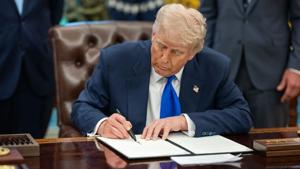
With President Donald Trump signing the memorandum of understanding with Iran, the latest agreement ushers in a new round of talks with the Islamic Republic over its nuclear program while omitting its support for terror proxies, ballistic missiles and human rights abuses.
As Vice President JD Vance confirmed, the 60 days of negotiations with Iran began Thursday. Agreements in the MOU have started to take effect, as the U.S. naval blockade on Iranian ports has been lifted, as confirmed by U.S. Central Command.
While the 14-point MOU does address nuclear concerns, with Iran promising to “not procure or develop nuclear weapons,” Trump’s chief concern with the Islamic Republic.
However, the MOU omits Iran’s financial and material support for terror proxies, including Hezbollah, Hamas and the Houthis.
Earlier during the negotiation period, The Center Square asked the president what concessions were being considered in a deal with Iran. Trump wouldn’t confirm that Iran’s support for the proxies would be omitted from talks, simply reiterating that Iran would not develop a nuclear weapon.
Despite there being no inclusion of terror proxies in the text of the MOU, the first article calls for a ceasefire in Lebanon, centered on Israel’s response to attacks from Hezbollah. The terror group, based in Lebanon, has become a source of contention in the region, with Trump expressing a desire to see the group disarmed.
In addition to the lack of language addressing Iran’s terror proxies, questions surrounding the Islamic Republic’s ballistic missile production have been raised. The Trump administration maintains that Iran’s ballistic missile stockpile and launchers have been drastically diminished.
While in France for the G7, the president was asked about the Islamic Republic’s missile program. Trump appeared to defend Iran’s right to maintain the missiles, citing other countries in the region possessing them.
“If other countries have them, it’s a little bit unfair for them to not have some…If Saudi Arabia and Qatar, and they all have some, I would say in relative proportion, I think it’s OK,” the president told reporters.
Trump argues that a majority of Iran’s missile arsenal has been destroyed; however, the New York Times cited intelligence agencies that believe the Islamic Republic has maintained up to 70% of the missile launchers and stockpiles.
During Trump’s address following the initial attacks on the Islamic Republic on Feb. 28, the president vowed to “destroy their missiles and raze their missile industry to the ground.”
Another point omitted from the MOU involves Iranian human rights, which the president has often cited throughout the conflict and leading up to the strikes. The MOU goes as far as prohibiting each other from “interfering in each other’s internal affairs.”
During Trump’s address on Feb. 28, the president accused the country of killing “tens of thousands of its own citizens. He called on the Iranian people to rise and take back their country.
“To the great proud people of Iran, I say tonight that the hour of your freedom is at hand … When we are finished, take over your government. It will be yours to take. This will be probably your only chance for generations,” said Trump.
While the MOU isn’t the final deal, it is unclear from the messaging from the Trump administration if the U.S. will press to include the ceasing of support for Iranian terror proxies, the production of ballistic missiles, and if the administration still encourages the Iranian people to rise against the current regime.
Vance told reporters Thursday during a White House press briefing that he believes talks with Iran will begin in Switzerland over the weekend.