


Financial markets expect the Federal Reserve to leave interest rates unchanged this week. That remains my expectation. But the case for another increase is getting harder to dismiss.
Regardless of the Fed’s decision next week, American households won’t get much relief. Prices are rising faster than wages, a frozen labor market makes finding a better-paying job harder, and borrowing costs remain stubbornly high. The recent stock market pullback adds pressure on households relying on investment gains to support their spending.
The Fed has historically preferred to prepare markets before raising rates. Signaling helps borrowing costs adjust before the decision arrives and reduces unnecessary disruption. As Ben Bernanke explained, clearer communication makes rate decisions more predictable and allows the economy to adjust more smoothly.
Fed Chair Kevin Warsh wants markets to draw their own conclusions from economic data rather than rely on the Fed to announce its next move in advance. At Jackson Hole, he argued that excessive forward guidance can constrain policymakers and weaken the information coming from financial markets. That makes the Fed’s historical preference for avoiding surprises a less reliable guide today.
Still, several influential officials have signaled room to wait. New York Fed President John Williams said September 29 that there was “no need for urgency,” while leaving another hike late this year on the table. Governor Christopher Waller said October 8 that further increases would likely be needed, but “the hikes do not need to come at consecutive meetings.” Vice Chair for Supervision Michelle Bowman said October 14 that she felt no urgency to act again while assessing how the economy responds to September’s increase.
My reading: those comments support an October pause while keeping December in play. With markets assigning roughly a one-in-ten chance of a hike, an increase would still be a substantial surprise.
A pause, however, would offer little reassurance about inflation.
My September nowcast puts headline personal consumption expenditures inflation at 0.48% month over month, lifting the annual rate to approximately 3.6%, from 3.4% in August. Core PCE, which excludes food and energy, is estimated to rise 0.27% in September, leaving annual inflation at about 3%.
Beyond the latest inflation readings, the Fed is paying close attention to inflation expectations.
The Cleveland Fed’s estimate of inflation over the coming year rose to 2.98% in October, from 2.66% in September and 2.40% in August. That is the highest since June, although still below the spring peak. Its model combines Treasury yields, inflation data, inflation swaps and surveys to estimate expected CPI inflation. It is not a PCE forecast, but it points in the wrong direction.
The recent climb matters because expectations can influence behavior. Businesses expecting higher inflation may become more willing to raise prices. Workers may seek larger raises to protect their purchasing power. That can make an initial energy shock harder to contain.
Rising expectations could pull some committee members toward another hike. They do not establish that inflation has become self-sustaining, but they weaken the argument that policymakers can simply wait for energy pressures to fade.
For most Americans, a Fed pause offers little immediate relief.
Higher prices absorb more of each paycheck. Expensive credit makes it harder to bridge the gap. A frozen labor market limits opportunities to find a better-paying job. Together, those pressures should gradually weigh on consumer spending as household financial cushions shrink.
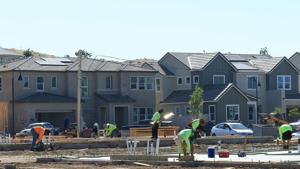
Housing is a prime example of what happens when rates stay too high for too long.
Tuesday brings new-home sales. Wednesday’s advance report covers the goods trade deficit and wholesale and retail inventories, providing important inputs for estimates of economic growth.
I expect home sales to remain weak following the rise in mortgage rates above 7%. August sales increased 6.4% from July, but remained 2% below August 2025. August’s improvement came before mortgage rates rose and stayed above 7%, making monthly payments even more expensive for new buyers.
Buyers were already adjusting: more than half of August’s new-home sales were below $400,000, compared with 46% a year earlier. Builders have supported demand through mortgage-rate buydowns, incentives and cheaper homes.
Those adjustments help keep homes moving, but they squeeze builders’ margins and discourage new construction. High borrowing costs also make renovations harder to finance, while fewer home sales mean fewer buyers taking on remodeling projects or purchasing appliances and furniture.
Still, the economic stakes extend well beyond construction. A housing slowdown also reduces demand for real estate services, building materials, appliances and furnishings, weighing on jobs, household incomes and economic growth. That is what the Fed must weigh against the risk of inflation remaining entrenched above its 2% target.