
Democrats in North Carolina, convening Saturday for the annual state convention and Unity Dinner, are going to have it both ways when it comes to the escalating civil war within their political party.
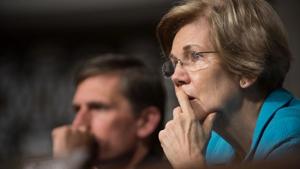
U.S. Sen. Elizabeth Warren, D-Mass., is the keynote speaker and will roll in having endorsed the Democratic Socialists of America platform via support in writing and appearances for New York City Mayor Zohran Mamdani, Michigan U.S. Senate candidate Abdul El-Sayed, and former Maine U.S. Senate candidate Graham Platner.
Warren, once upon a time identifying as a “capitalist to my bones,” says Mamdani’s movement represents what the party should look like.
Democrats coming together in the Raleigh Convention Center will be heavily focused on increasing support for the campaigns of U.S. Senate candidate Roy Cooper, incumbent Democratic state Supreme Court Justice Anita Earls, and candidates for the General Assembly, where only 20 of 50 Senate seats and 47 of 120 House of Representatives seats are blue. And neither Cooper nor Earls is endorsed by the Democratic Socialists of America.
In fact, before 2025 was done and less than six months into the campaign, Cooper was fending off contentions that he was aligned with the group trying to shift policy within the greater Democratic Party. Warren’s ideas on the party’s future and her invitation resuscitate the conversation.
Just where Democrats in North Carolina go next could be transformational. The party’s dominance in the state was only frayed a little at the edges – losses in federal elections, overwhelming majorities in Raleigh – in the back end of the last century.
This century, however, has tumbled to record lows.
Cooper, without using the word moderate, maintains he’s bipartisan and independent despite calling Republicans “extremist,” using multiple rounds of litigation against voter-approved and Republican majority-led legislation, and setting records for vetoes and executive orders while governor.
Earls, prior to Cooper making her a state-level judge, spent her career as a barrister working on civil and voting rights, in large part through her founding of the Southern Coalition for Social Justice.
Cooper’s ballot rival is Republican Michael Whatley. Earls is up against former state Rep. Sarah Stevens, R-Surry. Republicans held their convention without a lightning rod as powerful as Warren, hosting the traditional Saturday night Old North State Dinner last month in Greensboro with Whatley as the featured speaker.
The Democratic Party, on a national scale, has tension in an ideological tussle for control. Democratic socialism is on the rise, replete with a desire not only for social reforms but also restructuring, including abolishing the U.S. Senate, having Congress pick the president and U.S. Supreme Court, defunding the Pentagon, and allowing all residents, regardless of citizenship, to vote.
What’s commonly called the establishment Democrats, meaning mainstream members supportive of traditional institutional norms and pragmatic changes rather than complete overhauls, are being tested in their “big tent” slogan. Not all candidates connected to the rising tide agree with all tenets, and that’s no different from either main party today or in yesteryear.
The Democratic Socialists of America have 2026 primary wins by incumbent U.S. Rep. Alexandria Ocasio-Cortez in New York’s 14th Congressional District, Claire Valdez in New York’s 7th Congressional District and Darializa Avila Chevalier in New York’s 13th Congressional District; Christopher Rabb in Pennsylvania’s 3rd Congressional District; Melat Kiros in Colorado’s 1st Congressional District; and Mai Vang in California’s 7th Congressional District.
On its website “about us” section, the Democratic Socialists of America say, “Capitalism is a system designed by the owning class to exploit the rest of us for their own profit. We must replace it with a democratic socialism, a system where ordinary people have a real voice in our workplaces, neighborhoods, and society.
“We want to win ‘radical’ reforms like single-payer Medicare for All, defunding the police/refunding communities, the Green New Deal, and more as a transition to a freer, more just life.”
In a year like no other, with the nation’s eyes on a U.S. Senate race in the Tarheel State, Cooper’s campaign stumps, his state party convention, and its respective key speaker’s platform are at odds.
For example, Cooper says in one ad last month, “There is nothing political about keeping your family safe.”
He then points to his role as former attorney general in locking up “thousands of violent criminals” and keeping them in jail. Later, as governor, he says he strengthened bail laws and went “after drug dealers pushing fentanyl.”
The message was contrasted in the past week when DSA co-chairwoman Megan Romer told a network broadcast that there would be no borders or prisons.
Cooper was with scores of other Democrats, particularly on a national scale, in support of Platner until a sexual assault accusation against him surfaced earlier this month. Warren was, too.
The support existed even as it was known Platner had a chest tattoo resembling the Nazi-era death’s head symbol; social media posts of a misogynistic, racist and homophobic nature; dismissal of sexual violence; interactions with antisemitic podcasts; text messages early in his marriage suggesting infidelity; and ex-girlfriends’ depictions of a heavy drinker with aggressive behavior.
Warren dismissed all those, encouraging voters as late as June to see him for present-day growth. Warren, Cooper and a slew of others withdrew support within hours of the July 6 report from Politico on his relationship with Jenny Racicot. The Platner campaign was sudden death within hours.
And Warren on Saturday will undoubtedly encourage North Carolina Democrats to get more people out to vote for the party, and to donate money to campaigns. She’ll echo those kinds of words from the party chairwoman, Anderson Clayton, who on Feb. 11, 2023, was elected to her post.
Then 25, she’s 28 today and leading a party with 95,577 fewer registrations than when she took over. While the state roll has increased 595,523 in that time, 91.9% have chosen no party (547,348 unaffiliated) and 23.8% chose Republican (141,686). The Democrats’ losses are a minus-16% share, and a net negative difference of 237,263 to their archrival party.
It’s a continuation since Clayton was a toddler, the party as recently as 2004 having more than 47% of the state’s registrations now at an all-time low 29.7%.
Cooper is and has been the face of the state party for years. Saturday night, Warren brings it the Democratic Socialists of America.