


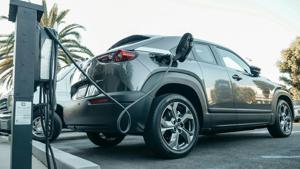
An often-used federal law that allowed California to set its own vehicle emissions standards is being challenged in court this month, potentially barring the Golden State from meeting its goal of banning sales of new gas-powered vehicles by 2035.
Earlier this month, the U.S. District Court for the District of Columbia prevented the U.S. Environmental Protection Agency from submitting four separate Clean Air Act waivers for Congress to potentially repeal. Those waivers allowed California to institute its own vehicle emissions standards.
California officials have regulated the state’s air and vehicle emissions since 1967 when Gov. Ronald Reagan signed the Mulford-Carrell Air Resources Act and created the State Air Resources Board. The Federal Air Quality Act passed Congress and was signed into law the same year, with a provision that allowed California to set its own, stricter air quality standards.
Officials with the Air Resources Board did not respond to The Center Square by publication time on Thursday.
The Clean Air Act pre-empts state regulation of emissions from new cars and makes a limited exception for California, which can acquire waivers that authorize the state’s own stricter standards. A 1977 compromise allowed other states to adopt those standards. That created a two-track federal system that regulated states’ vehicle emissions using federal standards and the higher California standards.
Roughly 30% to 40% of the country adopted California’s vehicle emissions standards, according to Michael Buschbacher, managing partner for Washington, D.C.-based law firm Boyden Gray.
Congress has tried to repeal waivers allowing California to institute new regulations on electric vehicles, ships and off-road equipment. During a panel hosted on Monday by The Federalist Society, Buschbacher said the U.S. Environmental Protection Agency announced earlier this year it was sending six clean air waivers to Congress concerning California’s vehicle emissions standards. The EPA wants Congress to repeal those waivers.
Those six mandated either that only electric vehicles could be sold in California starting in 2035 or attempted to institute greenhouse gas emissions for electric cars and trucks, ships, and off-road equipment, such as lawnmowers, panel participants said.
In 2025, three of California’s clean air waivers that served as de facto electrical vehicle mandates were repealed by Congress. A fight ensued about those waivers functioning as generally-applicable rules, with Congress ultimately voting to reject the waivers. President Donald Trump signed the law that ultimately disapproved those waivers. California then sued the Trump administration, arguing that the determination was wrong. The ensuing case, California v. United States, was heard in federal court in Northern California. No ruling has been issued yet.
Congress introduced joint resolutions on all those waivers in an effort to repeal them. The U.S. House of Representatives voted to repeal two waivers last week that concerned air emissions from ships that dock in California ports, and the U.S. Senate will vote on those waivers in the coming weeks, Buschbacher said.
“It’s unlikely everything will get resolved before the election, but a lot of this is cooking right now,” Buschbacher said. “So instead of waiting for the legislative process to go through its normal course, California sued and said that the transmission of these waivers and the reclassification behind it was unlawful.”
U.S. District Judge Beryl Howell, based in Washington, D.C., issued preliminary injunctions in the case in September. Howell ruled that California demonstrated irreparable harm when the federal government kept the state from implementing its own vehicle emissions standards. Howell added that California also demonstrated it would likely defeat the federal government in the courtroom, based on the state’s arguments.
“I think almost every single step of the court’s analysis is wrong – really badly wrong,” Buschbacher said during the moderated panel. “Indeed, both in substance and rhetoric, I think beyond the pale of what we should expect from the Article III judges that make up our federal judiciary.”
Andrew Ceonzo, counsel to both U.S. Sen. Eric Schmitt, R-Missouri, and the Senate Judiciary Committee, said during the Monday panel that Congress wanted to be the one to make a final decision about policy regarding emissions standards using the Congressional Review Act, which provides Congress with a tool to overturn federal agency actions.
“The Congressional Review Act is a way for Congress to re-assert its legislative authority in a given area,” Ceonzo said during Monday’s panel. “It’s a way for Congress to step into that conversation between the administrative state and the courts, and to make the policy decision for itself. It’s Congress coming in and saying ‘We’re the policymaker here, we’re the Article I branch, and we’re the one who actually decides here what the policy is going to be.”
Ultimately, Ceonzo said, one judge shouldn’t be the one to determine an entire governmental policy.
“There’s kind of this modern notion that the only way to have accountability for power is that a judge gets to ultimately decide the issue,” Ceonzo said. “I don’t think that’s really the structure of our constitution. I don’t think that’s the structure of our government, where a judge gets the final word on everything.”
Other California agencies, including the Department of Motor Vehicles and the California Environmental Protection Agency, did not respond to The Center Square’s request for comment on Thursday. Lawmakers contacted by The Center Square on this story on Thursday also did not respond. And car manufacturers, including Ford, Chevrolet and Tesla, and gas companies, such as Conoco Phillips and Shell, did not respond.
California has long had the nation’s highest gas prices. On Thursday, the average was $6.24 a gallon, up from $4.65 one year ago, according to AAA. The national average was $4.48 a gallon.