


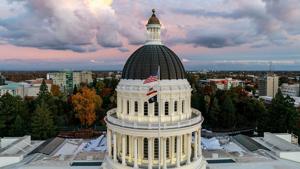
It’s costing taxpayers at least $1.1 billion, but there’s only so much lawmakers are allowing the public to know about the California Capitol Annex Project.
The project has been shrouded in secrecy for years due to thousands of nondisclosure agreements (NDAs) preventing people from talking about the project. Now a bill attempting to invalidate those secrecy agreements is set to die behind closed doors without any discussion, debate or public input.
Assemblyman Josh Hoover, R-Folsom, introduced Assembly Bill 2445 in February. Three months later, the same lawmakers tasked with running the Capitol Annex Project never assigned AB 2445 to a committee. The bill never received a hearing and is scheduled to automatically die on May 27.
Hoover said the irony is not lost on him; his idea to kill secret agreements is scheduled to be secretly killed rather than publicly debated, approved or voted down on the merits.
“It would seem odd to me that there’s so much passion to kill this bill,” Hoover said. “But, certainly, someone is pressing to keep this from getting heard.”
Signing away the public’s right to know
NDAs are legally-binding contracts that force people to keep information secret. There has been a nationwide push to prevent the use of NDAs in taxpayer-funded infrastructure projects.
“Non-disclosure agreements are, by definition, anti-transparent. They’re meant to hide information,” Hoover said. “They’ve been used to pretty much silence everyone involved with the project, including legislators, including construction workers.”
The Capitol Annex Project is slated to create one of the most expensive buildings in the United States. Gov. Jerry Brown approved the project in 2016, citing a need to replace an older building constructed in 1952. The project is being led by the Legislature’s Joint Rules Committee.
Critics of the project have been wary that only a small group of lawmakers get to pick and choose which information is made public.
“They’re effectively signing away the public’s right to know,” said John Mozena, president of the Center for Economic Accountability. “It’s really telling when you have public officials and public projects that are supposedly for a public purpose, but then they do everything they can to avoid public discussion and public transparency.”
Mozena’s organization was a founding member of the Ban Secret Deals coalition, which opposes the use of NDAs in subsidized projects. The organization has not specifically taken a stance on AB 2445, but Mozena said he is concerned with what he’s learned about the Capitol Annex Project.
“Nobody’s fighting against transparency when things are going well,” Mozena said. “These kinds of construction projects are very susceptible to corruption, especially when there’s no sunshine into what people are doing.”
The lawmakers who promised transparency
Leaders of the Legislature’s Joint Rules Committee provided an update on the Capitol Annex Project last December.
It was their first update in years.
In that update, they defended the use of Italian-cut granite being used on the project.
“Cutting the granite in Italy was the most affordable option that still enabled the use of California granite… Domestic bids would have delayed the project, resulting in increased costs.”
That assertion has been difficult to fact check. Records related to the Italian-cut granite have not been provided due to the NDAs.
The Center Square requested records related to the project two months ago. So far, no records have been provided.
Leaders promised another update in “early 2026,” which didn’t come until May 2026. At that time, they revealed the project was at risk of going $98M above budget and wasn’t set to be finished until October 2027.
Last week, in an email to lawmakers, Assembly Rules Chair Blanca Pacheco (D-Downey) and Senate Rules Vice-Chair John Laird (D-Santa Cruz) promised to provide updates to members of the media. But a spokesperson for Pacheco and Laird spent seven days declining to arrange an interview with The Center Square due to scheduling concerns.
Both lawmakers promised to do a better job providing updates to the public in an interview with a local television station last December.
“This interview is the first of many,” Pacheco said. “We believe it’s important for us to be transparent.”
David Kline, the vice president of communications and research for CalTax, said he’s not sure what the Joint Rules Committee is trying to hide by using NDAs.
“They should be giving taxpayers frequent updates,” Kline. “If there are problems causing tax increases, they just need to level with the public and tell us what they are.”
CalTax is a nonpartisan organization representing taxpayers in California. The group has not taken a public position on AB 2445 but is generally against NDAs on publicly-funded projects.
“People understand that construction projects sometimes take some turns you don’t foresee,” Kline said, “but when you try to wallpaper over it? That just raises suspicions. Just the appearance of things being hidden makes everything worse.”
According to the Capitol Annex Project FAQ page, NDAs are “necessary agreements commonly used in construction projects to maintain public safety by ensuring security information remains confidential.”
Both Hoover and Kline stated they understand the need for security information being kept private, but they believe that narrow excuse is being broadly applied to the rest of the project to justify secrecy.
“There are cases where NDA’s can serve legitimate business purposes in protecting trade secrets, but given California’s history of taxpayer-funded boondoggles, I imagine Californians would prefer to err on the side of too much accountability,” said Andrew Wilford, the director of state policy at the National Taxpayers Union Foundation. “California’s taxpayer-funded public infrastructure has an unfortunate history of resulting in too much ‘taxpayer funding’ and not nearly enough ‘public infrastructure,’ so a little more sunshine is exactly what the Golden State needs.”
For now, Hoover says his bill remains in “purgatory,” and he’s worried about future taxpayer-funded projects being kept hidden due to similar secrecy agreements. He believes lawmakers just gave them the road map.
“It’s been terrible to this point. It’s hard to get worse than what we have right now,” Hoover said. “We can criticize what has already happened, the lack of transparency over the last few years, but we can also fix it moving forward.”