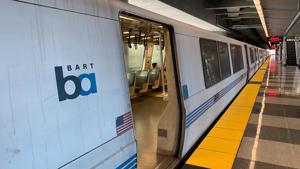
San Francisco Bay Area voters on Nov. 3 will decide on Measure RTM, a new sales tax aimed to keep BART and other public transit systems afloat after years of what’s described as inadequate post-pandemic financing.
Proponents said the 0.5% to 1% sales tax increase is a small price to pay for Bay Area Rapid Transit, better known as BART, and other regional transit systems as they recover from the post-pandemic ridership slump. Opponents argued the estimated annual, nearly $1 billion tax over 14 years is an avoidable regressive tax that comes as people are struggling with the cost of living.
BART is facing a 2027 budget deficit of $375 million, according to an agency report.
Measure RTM asks voters in five Bay Area counties – Alameda, Contra Costa, Santa Clara, San Mateo and San Francisco – to increase sales taxes by 0.5% and 1% over the next 14 years to support BART, Oakland’s AC Transit, Muni, Caltrain and several other regional public transit systems as they struggle from the post-pandemic ridership drop.
The sales tax increase would generate an estimated $980 million annually, according to the proposal.
BART ridership has steadily increased year-over-year since the lows experienced during the COVID-19 pandemic, but remains at about half the system’s pre-pandemic average as of 2026, according to the agency’s data, but BART is expressing optimism.
“We’ve seen some really encouraging trends on ridership, and it has definitely been on the upswing, especially this year,” BART spokesperson Christopher Filippi told The Center Square, adding that ridership had increased roughly 14% since last year. “It’s a really significant jump, and that’s a jump that’s been pretty consistent throughout 2026.”
BART, more than almost any other transit agency, depends on fares for its operating budget, Filippi said.
BART was roughly 71% paid for by ridership fares and parking fees in pre-pandemic years, but has fallen to just 32% in 2026. “So that’s what leads us to an operating deficit,” Filippi added in reference to the $375 million deficit for 2027.
Blame for the decrease in BART ridership and revenue post-pandemic has widely been put on the shift to Bay Area residents working from home.
“Remote work has changed how Bay Area residents live, work and travel,” read BART’s financial deficit report. “It has hit BART and all other public transit systems hard, decimating transit ridership and, along with it, the transit fare revenue we rely on to keep trains running. “
A June report from the San Francisco Chronicle found that the San Jose-San Francisco-Oakland metro area is among the highest in the country for work-from-home rates.
“Without funding from the RTM initiative, these transit agencies will need to sharply reduce service,” Sara Greenwald, a public transit activist at the climate justice organization 350 Bay Area Action, told The Center Square. 350 Bay Area has endorsed Measure RTM.
Greenwald warned what would happen if RTM doesn’t pass.
“Buses and trains will become much less frequent. In some cases, the average wait time will double,” added Greenwald. “Some bus lines will be canceled altogether. Even if funding is restored later, the agencies will take a long time to recover, so many riders will have to switch to cars.”
Without the additional funds, BART announced a plan, set to start in January 2027, to severely cut operations by 63% in train hours, increase parking and ride fees by 30%, lay off 600 employees and continue to defer benefits among other changes.
The sales tax increases, proponents argued, are a comparatively small price to pay to prevent these transit operation cuts. 350 Bay Area Action estimated the average cost for non-San Francisco residents would be $8 per month.
But opponents have said the agency should look to other sources to cut costs and increase revenue.
“Transit agencies should find expenses that don’t affect riders to rein in,” Contra Costa Taxpayers Association President Marc Joffe told The Center Square. The group opposes Measure RTM.
Joffe listed executive compensations and employee benefits such as free rides for relatives and retiree benefits as expense cuts to make. He also argued the agency should look to pause or altogether stop BART’s $12.2 billion San Jose expansion, or divert funds from the state’s $135 billion high speed rail line between San Francisco and Los Angeles, both of which have been plagued by delays and budget overruns.
But Filippi said expenses were not the issue for BART’s budget crisis.
“We’re really holding the line when it comes to cutting costs,” said Filippi. “We’ve eliminated more than 670 vacant positions. We have a strategic hiring freeze. We have had a freeze on management salaries. We’re even running shorter trains to save energy costs.”
Filippi also highlighted $516 million the agency saved in operational costs between 2020-2025 and an ongoing financial efficiency review.
Joffe also argued a sales tax was not the best way to generate revenue for the transit systems.
“Sales taxes are regressive, meaning that they impact poorer people more than affluent people because affluent people tend to save more of their income,” said Joffe. “Poorer people tend to spend more of their income, and they spend it on things that are subject to their sales tax.”
Greenwald agreed. “We would prefer a more equitable tax, we don’t prefer a sales tax, but we feel that the tremendous loss it would be if our public transit systems around the Bay Area started going bankrupt, that would be even worse.”
Both 350 Bay Area Action and the Contra Costa Taxpayers Association said they were optimistic about the ballot measure vote going their way.