


Annual vendor spending at Washington’s Department of Social and Health Services (DSHS) jumped $2.9 billion in four years, but a state audit assuring taxpayers that the surge was “valid” relied on a small, hand-selected sample of just 11 vendors.
Experts say the sample should not have been used to draw such broad conclusions.
According to the Washington State Auditor’s Office, DSHS paid more than 17,000 vendors approximately $8.6 billion in 2025, up roughly 50% from $5.7 billion in 2021. Of those 17,000 companies, auditors identified more than 1,000 vendors whose payments showed unusually high or “exponential” growth.
“When payments to a government vendor rise unusually fast, it can signal potential fraud, waste or other concerns,” acknowledged State Auditor Pat McCarthy. “Exponential growth in vendor payments can also be legitimate. We found the latter was the case.”
But to reach that “legitimate” conclusion, just 11 vendors received an “in-depth” review, or “closer inspection,” according to the auditor’s report. Each vendor was handpicked – not randomly selected – through a process called judgmental selection.
Even with the small sample size of 11 vendors, the in-depth review did not come back entirely clean. Auditors “found two cases in which vendors inappropriately billed DSHS.”
“In one case, DSHS found and corrected overpayments in a timesheet before paying this vendor,” auditors wrote. “In the second, a translation services vendor billed for both rescheduled appointments and the original, canceled appointments. After we notified DSHS, staff began to review all invoices from this vendor and plan to recover funds for inappropriately billed services.”
Experts interviewed by The Center Square said the small sample size makes it impossible to reach a conclusion that the $2.9 billion increase in spending was “valid” or “legitimate,” just as it would be equally inappropriate to extrapolate two out of 11 – or 18% – of vendors billed the government inappropriately.
“Clearly they didn’t have enough evidence to reach a conclusion,” said Tom Hall, an accounting professor at the University of Texas at Arlington. “They’ve stretched things beyond what they should have said.”
The State Auditor’s Office ultimately concluded its “review did not identify a pattern of inappropriate vendor payments” and issued no recommendations to DSHS. In a press release to the public, the office portrayed its findings with an encouraging headline: “Auditor finds recent surge in statements to vendors to be valid.”
Hall credited auditors for specifying in their report that “the findings cannot be projected onto the entire population of DSHS’ vendors,” but he was hesitant to speculate why an elected leader like McCarthy or her public relations team would still choose to broadly paint the increased spending as “valid” or “legitimate” in their conclusions and press releases.
“The reassuring tone of the report and the failure to recommend improvements in controls over the payment system are probably deserving of criticism,” Hall said. “Perhaps the auditor was under pressure to avoid public criticism of the state government on this issue.”
Kathleen Cooper, director of communications for the State Auditor’s Office, defended the news release written by a member of her team.
“I don’t find any super inconsistencies,” Cooper said in an interview with The Center Square. “Our attempt in a press release is usually to try to be as high level as possible so that it’s more accessible information to a broader group of people… I think it was just an attempt to try to simplify the topic that we’re talking about and think of what areas might be of interest to people.”
Cooper also defended the judgmental selection of 11 vendors for in-depth review, stating they were chosen due to potential risk factors. She described the practice as “common” and indicated a larger sample size of 44 additional vendors was also reviewed, albeit less thoroughly.
“Every audit has to make decisions about how to scope something so that we can actually do work in a reasonable period of time,” Cooper said. “We can’t examine with our human eyes, like, every single thing.”
Experts interviewed by The Center Square agreed judgmental selection is a valid technique, but they warned against using the process to draw broad conclusions validating a $2.9 billion increase in spending.
Hall estimated a department with 17,000 vendors could be responsible for approximately 5 million individual payments. He recommended a sample size of “5,000 or 6,000 elements” to reach broad conclusions.
“I would have wanted to see a representative sample and testing for validity within that sample,” Hall said. “I don’t think there was any testing for validity.”
Earlier this year, McCarthy declined to expand the scope of an existing audit to investigate payments to daycares that showed few signs they cared for children. The situation was uncovered by The Center Square after repeatedly going to several daycares that received tens of thousands of dollars in state subisidies. Instead of investigating, the State Auditor’s Office told The Center Square to not be “knocking on doors” of any daycares.
“It’s kind of stunning that they would say that, but, on the other hand, it’s not really that surprising,” Sen. John Braun, R-Centralia, said in May, calling for an investigation.
Auditor wants to increase trust
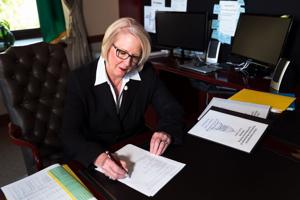
At the bottom of each audit, a photo of McCarthy appears with a quote highlighting her vision to “increase trust in government.”
Her biography includes similar messaging, emphasizing a dedication to “increase public trust in government.” The consistency of her statements have caused some to question whether McCarthy’s stated goals prompted her to selectively emphasize positive results and deemphasize negative results of the DSHS audit.
David Heald, an emeritus professor at University of Glasgow and former advisor to the U.K. Parliament, has spent years studying the relationship between government auditors and public trust.
“The task of public audit is not to make citizens trust governments and politicians,” Heald wrote in a research paper in 2018. “If public audit demonstrates that government is wasteful and corrupt, then there might be less trust.”
Heald agreed to review the audit of DSHS for The Center Square as a neutral third party. He also reviewed McCarthy’s campaign statements and outward-facing materials.
“If you’re in a country which is a corrupt dictatorship, more information through transparency is actually – if anything – going to reduce trust in government!” Heald said. “Public auditors should not be trying directly to generate trust… No organization is perfect, and governments are not perfect. The point is the auditor actually finding the problem and recommending it’s dealt with.”
According to her communications director, McCarthy was not available for an interview with The Center Square.
“She’s out of town, and she won’t be available next week either,” Cooper said.
Heald said he did not feel comfortable reading too much into the sample size of 11 vendors, noting that audit scope is inevitably affected by available resources. His larger concern after reviewing the report was that it focused heavily on whether payments complied with rules rather than addressing what drove the $2.9 billion spending increase.
“What struck me was the sheer scale of that increase,” Heald said. “What is behind the spending? If I was a member of the state legislature, that’s the question I would be asking.”
The audit provided only the following explanation: “In most cases, multiple factors contributed to increases either in service scope or service rates, which can have an exponential effect. For the 11 reviewed vendors, higher service rates or product prices and increased caseloads were the most common factors contributing to rising vendor spending. The five factors identified were: increased service rates or product prices, increased caseload, improvement projects, program expansion, payment schedule adjustments.”
Heald also questioned why the audit produced no recommendations despite finding at least some payment problems.
Hall, the professor at University of Texas at Arlington, agreed.
“Oddly, the auditor had no recommendations for improvement,” Hall said. “There should have been recommendations to improve internal controls used in the payment system.”
Cooper described McCarthy as an elected official who appropriately balances the need for making the public “feel better” about government and its “really good work for people,” while also holding the government accountable.
“We tell the truth about what we find without fear or favor,” Cooper said. “(McCarthy) believes that the public is in the best decision to make a decision about what to do about what we find.”
Anonymization
But from reading the report, it’s impossible for the public to know which companies were examined by auditors.
Auditors specifically avoided including the names of vendors in the report. For example, a 6800% spending increase for one company simply identified the recipient of taxpayer funds as “IT solutions vendor.”
Cooper promised a full list of vendors would be supplied to The Center Square in response to a public records request. She described the anonymization of vendors as a “judgment call” and common practice that is only broken under specific circumstances.
“It is our practice that we don’t name specific vendors,” she said. “We do not have a hard and fast policy… We just have a general practice and philosophy that we try to implement.”
The office has made different judgment calls in other audits.
In 2021, for example, the State Auditor’s Office publicly identified Freedom Project and its subcontractor King County Equity Now while examining a controversial $3 million Seattle contract. McCarthy personally criticized the city for exercising what she called “only the bare minimum of accountability and transparency.”