

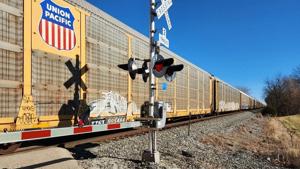
The proposed Union Pacific-Norfolk Southern merger’s economic, health and environmental benefits could be worth as much as $5.8 billion annually, according to a new study.Economist William Michael Cunningham released the Creative Investment Research study this week.His estimates come as the railroads say a merger would shift 2.1 million truckloads of cargo to rail annually, reducing carbon dioxide emissions by nearly 3.8 million metric tons.The companies think they’ll save $3.5 billion in shipping costs annually. Meanwhile, Cunningham thinks there willll be an additional $500 million to $1.6 billion in health benefits from less diesel pollution and $194 million to $722 million worth of environmental benefits.His study adds together the lower freight costs with those health and environmental benefit numbers.”The public-interest test should require that these projected benefits are documented, delivered and shared,” Cunningham said in a release.His model thinks the shift could stop about 94 premature deaths yearly; his estimate ranges from 47 to 141 lives.The calculation figures each converted load means 1,000 fewer truck miles.The firm says its health estimates would be more accurate with more information, like route changes and increased rail activity. Union Pacific and Norfolk Southern announced the proposed merger last year. The deal valued Norfolk Southern at $85 billion. Their combined rail network would cover over 50,000 route miles in 43 states.The companies say one carrier would move freight across America more efficiently. Union Pacific says transfers often add 24 to 48 hours to shipments.Farm groups have mixed feelings about the deal, as The Center Square previously reported.Ethanol producer POET and Minnesota Soybean Processors support it. They think it will help them reach more customers. But the American Farm Bureau Federation and National Farmers Union oppose it. The Farm Bureau says grain producers can’t easily switch to trucks and barges if rail prices increase.”History has shown us that when railroads consolidate, family farmers pay the price,” National Farmers Union President Rob Larew said.There’s also no consensus among labor unions, as The Center Square reported.For example, SMART-TD backs the deal, but the Teamsters Rail Conference opposes it.The Surface Transportation Board still has to approve the merger. Two rival freight carriers, BNSF and CSX, asked the board to reject the merger application without reviewing it. In September, the board denied that request. Even so, it hasn’t approved the deal yet.