


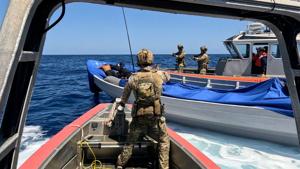
In less than one week, a U.S. Coast Guard crew seized more than 25,000 pounds of cocaine across three interdictions in the eastern Pacific Ocean.
Their efforts are part of an international drug trafficking interdiction effort, Operation Pacific Viper, launched in August 2025. Since then, Operation Pacific Viper USCG crew members have seized more than 260,000 pounds of cocaine.
“We own the sea, and Operation Pacific Viper is proving that every day,” Admiral Kevin Lunday, commandant of the Coast Guard, said. “Coast Guard crews are taking the fight to narco-terrorists in the maritime domain, denying them the routes they rely on to move drugs, money and violence, while protecting the homeland and disrupting transnational criminal organizations far from U.S. shores.”
Operation Pacific Viper was launched as part of the Trump administration’s border security efforts, which expanded the Coast Guard’s interdiction efforts to combat cartel operations at sea.
The eastern Pacific Ocean is considered a primary corridor for narcotics smuggling from Central and South America. USCG cutters, aircraft and tactical teams have been surged in the region to interdict, seize and disrupt the flow of cocaine and other illicit drugs. “These efforts are a critical component of the broader U.S. strategy to combat narco-terrorism and dismantle transnational criminal organizations,” the USCG says.
Their efforts are directed through U.S. Southern Command’s Joint Interagency Task Force-South, based in Key West, Florida. Interdictions are performed under the authority and control of the USCG Southwest District, headquartered in Alameda, California. The USCG is part of the U.S. Department of Homeland Security.
In the three most recent interdiction efforts, on Sept. 11, maritime patrol aircraft unit identified a go-fast vessel south of Costa Rica. U.S. Coast Guard Cutter Tampa responded and launched its cutter boat and embarked helicopter to intercept it.
The helicopter crew employed effective warning shots before USCG law enforcement personnel boarded the vessel. Once on board, they found suspected contraband that tested presumptively positive for cocaine. The crew then seized more than 6,800 pounds of cocaine, embarked three suspected smugglers and sank the vessel as a hazard to navigation.
On Sept. 15, USCGC Tampa crew found two suspected drug-smuggling vessels south of Panama and interdicted them both. They then seized more than 15,000 pounds of cocaine and embarked six suspected smugglers. The next day, they interdicted another vessel south of Panama seizing 3,456 pounds of cocaine.
Combined, they seized more than 25,256 pounds of cocaine. Since last August, Operation Pacific Viper crew have seized approximately 119,165 kilograms, or more than 262,000 pounds of cocaine in the eastern Pacific Ocean.
The Department of Homeland Security estimates that a lethal dose of cocaine is 1.2 grams, which would mean that the amount of cocaine USCG crew seized in the three interdictions was enough to kill an estimated 9.5 million people. Since August 2025, the Coast Guard seized enough cocaine to kill 99 million people, according to the 1.2-gram metric.
The Center Square has used the 30-milligram lethal dose metric, noting that previous federal agency seizures took enough cocaine off the market to save billions of people. Using the 30-milligram metric, Operation Pacific Viper crew seized enough cocaine to kill 3.9 billion people.
The Coast Guard is not alone in its efforts. U.S. Customs and Border Protection and Border Patrol agents are seizing record amounts of cocaine and other illicit drugs. Drug seizures are up overall under the Trump administration as more Border Patrol agents and USCG crew are in the field.
In one major drug bust in California alone, Border Patrol agents seized 2,270 pounds of cocaine, enough to kill 34 million people with 30 milligrams considered a lethal dose, The Center Square reported. In the first seven months the fiscal year, which began last Oct. 1, CBP agents working out of 54 ports of entry in California, Arizona, New Mexico and Texas seized more than 100 million lethal doses of fentanyl, The Center Square reported.
CBP agents at ports of entry and Border Patrol agents between ports of entry nationwide have seized 73% more drugs this fiscal year through August than what they seized during the same period in fiscal 2024, The Center Square reported.
This year’s drug seizures are 61% higher than the last four years’ average, CBP said.
Cocaine seizures increased 28%, with 6,724 pounds alone seized last month. Fentanyl seizures remain high; 773 pounds of fentanyl were seized in August.
Working with U.S. Immigration and Customs Enforcement, CBP also helped seize more than 120,000 pounds of precursor chemicals used to make illicit drugs last month, The Center Square reported.