


China remains behind on its May pledge to buy U.S. farm goods as President Donald Trump hosts Chinese President Xi Jinping, with a trade truce set to expire Nov. 10.
The talks could decide whether suspended higher tariffs on some Chinese imports take effect, whether U.S. farmers see the sales Beijing promised and whether the two countries extend the one-year truce they reached last fall. The Tax Foundation, a nonpartisan tax-policy nonprofit, estimates all U.S. tariffs combined will cost the average household $820 this year, and the Yale Budget Lab, a nonpartisan policy research center, puts the annual cost at about $1,100.
China agreed in May to buy at least $17 billion a year in U.S. agricultural products through 2028, in addition to an earlier commitment to buy soybeans. Through July, China had bought $3.9 billion in U.S. farm goods outside soybeans, according to U.S. Department of Agriculture trade data. At that pace, it would buy about $6.7 billion this year, short of even a prorated share of the $17 billion target.
Including soybeans, China bought $8.8 billion in U.S. agricultural products through July, up about 50% from $5.9 billion in the same period last year. For all of 2025, U.S. agricultural exports to China fell to $8.3 billion, down from $24.4 billion in 2024.
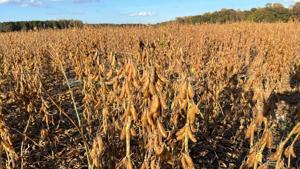
Soybeans have driven most of the increase. China bought $4.9 billion in U.S. soybeans through July, nearly double the same period last year, according to USDA. Chinese buyers have also booked about 9.9 million metric tons for the marketing year that began Sept. 1, though only about 330,000 tons, or roughly 3%, had shipped as of Sept. 10, USDA export sales data show. Illinois and Iowa are the top U.S. soybean exporters, according to USDA’s Economic Research Service.
Dave Walton, an Iowa soybean farmer and vice president of the American Soybean Association, said China appears on track toward a separate pledge to buy 25 million metric tons of U.S. soybeans this year.
“We like to hear commitments from Chinese buyers, but we also need to see beans on boats headed west,” Walton told The Center Square.
Treasury Secretary Scott Bessent said Monday that some deliverables from last fall’s trade truce “have not been completely fulfilled.” Asked on CNBC about the truce’s Nov. 10 expiration, he said, “I think we’re going to maintain that.”
U.S. Trade Representative Jamieson Greer was more cautious. He said Monday he did not expect an extension to be announced this week, barring something unexpected, and that any extension should come “incrementally to make sure that there’s compliance” because China “has created this uncertainty” by limiting rare earth exports. Asked whether three to six months was the right range, Greer told Bloomberg Radio, “That’s probably the right kind of range.”
Phillip W. Magness, a senior fellow at the Independent Institute, a think tank, said leverage requires discipline and narrow objectives, and that shifting U.S. trade goals have weakened Washington’s hand with Beijing.
“The last several months have diminished the credibility of U.S. threats, and pulling the trigger on more sweeping tariffs could lead to painful escalations of retaliatory measures against U.S. agriculture by China,” Magness told The Center Square.
In the same CNBC interview, Bessent pointed to a proposed “30-by-30” deal under which the U.S. and China would lower tariffs to most-favored-nation levels, the rates both countries charge most trading partners, on a set of what he called “non-critical goods.”
Bessent said the idea was floated during Trump’s May visit to Beijing and that Greer’s team met with Chinese officials Sunday to work out which items it would cover. For the U.S., it would mean “selling more agriculture, selling more energy” and medical devices, he said, while “on the Chinese side, it would be bringing in more everyday items.”
Magness said almost any genuine reciprocal tariff cut between the two countries “would likely result in some modest amount of relief to both American consumers and American exporters,” and could be “meaningful, particularly in hard-hit sectors.” U.S. soybean exports to China fell from $12.6 billion in 2024 to $3 billion in 2025, according to USDA.
The administration also has tariff tools in reserve. The Office of the U.S. Trade Representative opened an investigation in October 2025 into whether China has kept its commitments under the 2020 Phase One trade deal, and a separate investigation in March into excess manufacturing capacity in China and other countries. Neither had resulted in new tariffs as of Wednesday, according to USTR’s website. Greer said Monday that if the excess-capacity investigation finds problems, the administration could impose tariffs or take other measures.
A sanctions law Congress passed and Trump signed Sept. 18 also directs the president to impose tariffs of up to 100% on all goods from countries among the five largest buyers of Russian oil or natural gas that keep buying, with some exceptions, starting about a month after enactment. The law does not name China, which was the largest importer of Russian crude oil in 2024, according to the U.S. Energy Information Administration. The president can waive the tariffs by certifying to Congress that doing so is in the national interest.
If any of them are used, Americans would bear most of the cost, Magness said.
“The incidence or burden of the tariff falls primarily on the U.S. economy in the form of higher prices on imports,” he said. “That means imported raw materials will make U.S. manufactured goods more expensive, and imported consumer goods will cost more at the checkout line.”
The Congressional Budget Office estimated in February that consumers face price increases equivalent to 95% of tariff costs, with foreign exporters absorbing the other 5%. In May, CBO said more recent evidence suggests exporters’ share may have risen, possibly to 10% to 15% by the end of 2025.
The administration disputes that consumers bear the cost.
“I don’t concede that the tariffs went through to consumers,” Greer told senators at a July 22 Senate Finance Committee hearing. “A lot of them were eaten by foreign companies.”
Research on how tariff costs are split at the border has mostly found U.S. importers, not foreign exporters, bore 90% to 100% of the tariffs, according to a Sept. 1 Tax Foundation review. A July working paper by trade economist Caroline Freund found foreign exporters absorbed 40% to 50% of the 2025 tariff increases.
Tariffs are also a significant revenue source. Customs duties brought in $292.5 billion in the fiscal year through August, but $125.2 billion in refunds, driven by court-ordered repayment of tariffs after the Supreme Court ruled in February they were not authorized by a 1977 emergency powers law, cut net collections to $167.3 billion, about the same as a year earlier, according to the Treasury Department. That revenue “is already assumed in deficit projections, so it cannot serve as a pay-for,” the Committee for a Responsible Federal Budget, a nonpartisan budget watchdog, said this month.
Supporters of a tougher China policy argue the bigger risk is giving up leverage. Scott Paul, president of the Alliance for American Manufacturing, a manufacturing advocacy group, wrote in a Newsweek op-ed this week that Trump had been “unafraid to impose tariffs and other measures to recalibrate trade flows and derisk supply chains,” calling it “a welcome change” for American industrial workers.
But Paul wrote that Trump “risks squandering any leverage he’s created if he ignores China’s three big ‘C’s’ that spell trouble for American manufacturing: cars, currency and chips.”
Greer said the tariffs are working. “Our trade deficit with China has gone down by a third,” he said Monday. “The last time we imported this little from China was 2003.”
China’s global goods trade surplus exceeded $1.2 trillion in 2025, USTR said in March when it opened its excess-capacity investigation.
China also still charges a 10% retaliatory tariff on U.S. soybeans, which the American Soybean Association asked Trump to eliminate in a Sept. 17 letter. “We constantly hear from buyers that they prefer the quality of U.S.-grown soybeans, but the cost due to tariffs tips the scale against us,” Walton, the group’s vice president, said.
A White House official referred The Center Square to recent public remarks by Greer and Bessent. The U.S. Trade Representative’s office and the Chinese Embassy did not immediately respond to requests for comment. The U.S. Department of Agriculture said it needed more time to respond.
Trump is scheduled to welcome Xi at Joint Base Andrews on Wednesday evening, according to the White House. The truce expires Nov. 10.