


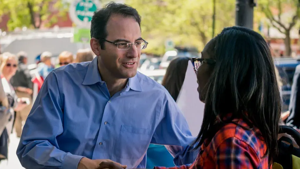
The Democratic candidate for Colorado governor, Phil Weiser, and his Republican challenger, Victor Marx, are each facing scrutiny regarding campaign donations.
Marx’s campaign currently remains at the center of an investigation following his primary win for the Republican Party last month, but recent reports raise flags surrounding Weiser’s campaign contributions as well.
Weiser, the current Colorado attorney general, won the Democratic primary for governor over state Sen. Michael Bennett by a 14-point margin. Marx, a former Marine and nonprofit leader won the Republican primary by less than 2,500 votes against state Sen. Barb Kirkmeyer of Weld County.
Weiser launched his bid for governor in January 2025 and has raised almost $7 million since he announced. Weiser has served as the Colorado attorney general since 2019 and previously worked in the U.S. Department of Justice under the Clinton and Obama administrations.
A vital messaging point of Weiser’s campaign is that he’s filed over 60 lawsuits against the Trump administration. He has expressed his stark opposition to Republican leaders on both national and state levels.
Marx, Weiser’s Republican opponent in the Nov. 3 general election, comes from an unusual background given his sudden interest in politics. The former Marine and nonprofit leader stepped in the political arena back in October 2025 and won 39% of the vote at the Republican Assembly, the Colorado party’s convention, in April. In recent months, his campaign received much scrutiny from his Republican gubernatorial opponents, Kirkmeyer and state Rep. Scott Bottoms of El Paso.
In fact, both Kirkmeyer and Bottoms announced on the Republican gubernatorial debate stage in June that they would not support Marx if he won the primaries.
Marx won by a less than a 1% margin against Kirkmeyer.
Now that the primaries have concluded in Colorado, the Secretary of State’s Office is reviewing campaign finances to ensure compliance with state laws. But recent reports have flagged the timing of some of Weiser’s campaign contributions, and roughly one month later, the Secretary of State’s Elections Division initiated an investigation into Marx’s campaign finances.
Findings on Weiser’s campaign
The Center Square looked into legal documents and lawsuits where the Colorado Office of the Attorney General was engaged in litigation with and had reached a settlement.
In 2025, the office was engaged in litigation against the cannabis company, MC Global Holdings, for allegedly misrepresenting the health benefits of its hemp products. The company settled with the Office of the Attorney General in May 2025, agreeing to pay a $50,000 fine. But in January of this year, the company was forced to settle again and pay another $75,000 fine for violating its initial settlement agreement.
The initial settlement document signed in December 2025 identified an attorney working on behalf of the defendant, MC Global Holdings, who was later found as being associated with the Denver-based law firm Brownstein Hyatt Farber Schreck.
The Center Square looked into campaign finance documents and found this particular attorney donated $100 to Weiser’s campaign four months after the final settlement agreement was reached.
The Center Square also found eight other attorneys currently employed by that firm who donated over $9,500 in total to Weiser’s campaign. These contributions came months before the initial settlement was reached, or a few months after the second agreement was met.
One contribution from the law firm came from its founder and chairperson, who donated the maximum amount allowed by an individual – $1,450 – exactly one month before the first settlement was reached with the Colorado Attorney General’s office.
Another attorney and partner at the Denver-based firm also donated the maximum amount throughout a period of three months beginning in March 2025 and ending in June 2025.
Some of these attorneys have supported Weiser in the past – both vocally and financially. One attorney had never donated to Weiser before but made a $100 contribution in April of this year – four months after the second MC Global Holdings settlement agreement. His other gubernatorial campaign donations went to Weiser’s opponent in the primary, Bennett. The donor made two subsequent $50 donations in May and June to Bennett.
In 2023, the Denver-based firm also hosted the 12th annual fundraiser for Senate Democrats, effectively raising over $500,000 to the Democratic Senatorial Campaign Committee – with over $120,000 of it coming from personal contributions.
The Center Square interviewed Weiser campaign spokesperson Nate Jackson, who said, “Phil’s campaign is people-powered. He follows our campaign finance laws, and he doesn’t take contributions from anyone involved in active litigation against his office or who works at a corporation his office is in litigation with.”
Jackson also clarified that the campaign donation from one of the individuals employed by Brownstein was made four months after the final settlement agreement was reached in January 2026 with MC Global Holdings. Jackson argued that since this contribution was made after active litigation efforts, it does not present a conflict of interest.
Though there have been no formal investigations initiated against Weiser’s campaign, this is not the first time his team has faced scrutiny over campaign donations.
In 2022, when Weiser was running for reelection for attorney general, reports filled local news channels regarding the $40,000 in campaign contributions from employees’ whose company was involved in a series of investigations with the Colorado Attorney General’s Office.
Marx’s campaign contributions investigated
The Elections Division with the Colorado Secretary of State Office filed an administrative complaint on July 23 against Marx after receiving over 100 complaints from Republican political operative Darcy Schoening.
The complaint alleges that Marx’s campaign accepted 197 illegal donations that totaled more than $78,000 over the allowed limit. The complaint also claims the campaign accepted another $1,000 in illegal cash contributions.
Schoening did not respond to The Center Square’s request to comment on the nature of her complaints.
Harry “Buddy” Jericho, Marx’s campaign manager, clarified in an interview with The Center Square that the complaint flagged 197 illegal donations across 111 different contributors.
“The overages generally arose in two ways. First, some donors made recurring or multiple contributions that, when added together over the election cycle, crossed Colorado’s $1,450 individual limit. Second, some direct-mail checks were received and deposited through our fundraising processor before the complete donor information reached the campaign, creating a delay in identifying aggregate overages,” Jericho said.
He said that even though these records remain public through Colorado’s TRACER system, the campaign remains responsible for its compliance systems.
He also stated that the campaign does not dispute any of the Secretary of State’s Office’s findings that some contributions exceeded the limit. The campaign does, however, dispute “any suggestion that this was an intentional effort to conceal contributions, evade the law or obtain money through fake donors,” Jericho said.
He added that the disputes will be addressed transaction by transaction through the administrative process.
And the campaign is actively issuing refunds and correcting aggregated contribution records, Jericho said.
One of the main messaging points of Marx’s campaign is accountability and transparency.
Jericho said accountability “does not mean claiming that mistakes never occur. It means acknowledging them, correcting them and changing the systems that allowed them to happen.”
He added that the campaign grew rapidly and was required to process very large volumes of contributions. As a result, “our compliance operation did not keep pace with that growth. That is an explanation, not an excuse.”
“Victor believes accountability must apply to candidates, campaigns and government – including his own campaign. We will not ask voters to accept a lower standard from us than the one we expect from others,” Jericho told The Center Square.
When asked about the scrutiny surrounding Weiser’s campaign contributions, Jericho said it “raises questions about conflicts of interest and the appearance of access or influence.”
What sets Marx apart from Weiser, according to Jericho, is that “he does not currently hold public office and has no governmental authority, contract, settlement or official action to offer any donor.”
“We are not asking voters to overlook our compliance shortcomings because Phil Weiser has faced separate scrutiny,” Jericho said. “Both candidates should answer legitimate questions with facts and transparency. But the legal issues, conduct and potential public consequences are materially different.”