


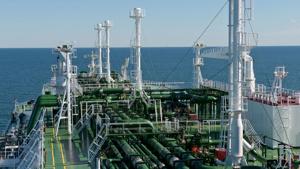
(The Center Square) – The U.S. Gulf Coast is becoming the country’s “emergency fuel hub” following the Trump administration’s suspension of parts of the Jones Act, a federal law that restricts shipments of energy-related cargoes between domestic ports to American-flagged vessels, according to analyses of maritime data.
Since suspending portions of the Jones Act, a 1920 law that generally requires cargo shipped between U.S. ports to travel on vessels owned, built and crewed by Americans, the Trump administration has granted more than 60 waivers, allowing foreign-flagged vessels to carry goods between U.S. ports, Maritime Administration data shows.
Shipments of oil, gasoline, diesel, and other liquid fuels went from U.S. refineries to Florida, California, New York and Puerto Rico for the first time in many years, according to RBN Energy. The Houston-based energy analytics firm tracked maritime shipments of oil, gas, diesel, jet fuel, fertilizer and other energy commodities to ports across the United States and its territories.
“The Jones Act waiver has reshaped crude and product flows within the U.S. in just a matter of weeks,” said Mike Shuler, editor of shipping industry publication gCaptain, citing the RBN analysis.
Disruptions to supply chains caused by Iran’s closure of the Strait of Hormuz became so severe that crude oil from the U.S. Strategic Petroleum Reserve in Louisiana recently traveled through the Panama Canal for delivery to California on foreign-flagged ships for the first time ever, according to RBN.
Through the third week of May, the Trump administration issued waivers for 61 foreign-flagged vessels hauling energy products or fertilizer between American ports, the data shows.
The waiver is “reinforcing the Gulf Coast’s role as the country’s emergency fuel hub,” Shuler wrote in a column on Thursday.
The Trump administration initially suspended Jones Act restrictions on energy-related cargoes on March 18 for a 60-day period but later added another 90 days with the target date now Aug. 17.
Shipping industry trade groups contend the Jones Act waivers undermine American jobs and place domestic maritime companies at a competitive disadvantage against foreign vessels. These groups further argue that the waivers fail to provide promised price relief to consumers and ultimately put American workers last.
“Clearly, President Trump has been led to believe that waiving the Jones Act is an effective way to lower gas prices, when we all see that prices have not gone down with the waiver,” said Jennifer Carpenter, President of the American Maritime Partnership. “What the waiver does is put America last by allowing foreign operators and mariners to take American business and jobs.”
The national average price of gasoline on Friday was $4.45 a gallon versus $3.84 a gallon on March 18, the day the waivers were announced.
Since the shipping restrictions on energy cargoes were lifted in March, marine terminals in Texas and Louisiana have dispatched an unprecedented number of refined products shipments to U.S. and international customers, including gasoline, diesel, propane, and jet fuel.
In recent weeks, the Singapore-flagged vessel Bulldog delivered 300,000 barrels of motor fuels from New Orleans to Florida, while the Liberia-flagged Trouvaille carried 70,000 barrels of diesel from Houston to Puerto Rico, according to RBN.
Another waiver allowed the Bulldog to load 300,000 barrels of motor fuels at the Valero refinery in New Orleans on March 12 for delivery to Port Everglades, Florida, on April 1.
According to Kpler data, the tanker Nord Ventura sailed for more than a month from Louisiana to deliver about 300,000 barrels of jet fuel to Melbourne, Australia, marking the first such shipment since 2017.