


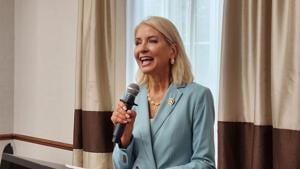
Society is turning away from family life and family values in pursuit of career, conservative women said Wednesday in a panel discussion hosted by the Heritage Foundation.
The family life conservative women showed interest in is marriage with children, though concerns were raised about this lifestyle becoming unaffordable.
“The path to marriage and to starting a family seems more and more out of reach and it’s not something that’s encouraged anymore,” Judy Lopez, program manager for DeVos Center for Human Flourishing at The Heritage Center, said. “We’re told children will slow you down, so it’s better to just put it off all together.”
“I’ve often said women can have both a family and a career, but usually not at the same time. That’s why I’m here in Congress fighting to save the most fundamental institution of society: the family,” U.S. Rep. Mary Miller, R-Ill., said. “It’s no secret that marriage is in serious decline, and couples are delaying or not having children at all.”
Another concern that was expressed is the affordability of marriage.
“The data now shows marriage is almost a luxury item, and that the only people getting married are people with higher educations,” Jennifer Galardi, senior policy analyst for DeVos Center for Human Flourishing at The Heritage Center, said. “Feminism hurt women, particularly on the lower end of the economic ladder.”
During the panel discussion, feminism was repeatedly described as a major cause for the change in values, including the view of being a mother.
“Sex has been divided from procreation,” Mary Rice Hasson, Kate O’Beirne Senior Fellow for Ethics and Public Policy Center, said. “If you’re a culture that is saying ‘have all the sex you want, babies are a hobby or babies are a lifestyle choice,’ well, what does that do? That means when you see when all of a sudden you discover you’re pregnant, a baby is a disaster.”
“One of the things that feminism is really forced upon us is this idea that our fertility is something that’s either optional or is problematic, and it’s really made us at odds with our own children,” Carrie Gress, author, said.
“They were, like, more part of society. Now, we have them cordoned off,” Carrie Severino, president of Judicial Crisis Network, said.
One question that was brought up was the use of childcare to allow women to work while raising their children.
“Unless you’re making a certain amount of money, a nanny or daycare is financially out of the question. You would be spending all of the money you can get from your job just to pay for the daycare, for someone else to watch your child, and eventually the math just doesn’t add up,” Emma Waters, policy analyst for Center for Technology and the Human Person at The Heritage Foundation, said. “If you look particularly at lower income women who have children, they by and large want to be either home full-time with their children or in flexible part-time roles that allow them to be present.”
Virtual and hybrid work triggered by the COVID-19 pandemic actually helped women in a work-based society in this aspect, panelists said.
“It is OK, it’s even normal, and it’s good to want children. What a surprise!” Judy Lopez said.
“They are the future of our nation, our children, and it’s up to us as mothers to nurture and instruct them to be the citizens our country desperately needs,” Miller said.
To repair society’s perspective of family values and parenthood, family oriented policies in both government and businesses were recommended.
“If you are an employer at any level, you have the opportunity to create programming policies,” Severino said, “that are accepting of women or employers being willing to have positions that explicitly job share.”
“Our solution for supporting the family can’t just be focused on the benefits we give mothers. It needs to be broader than that,” Waters said. “You want to compel men to work and to provide for their families and give them the resources they need to sufficiently do it.”