


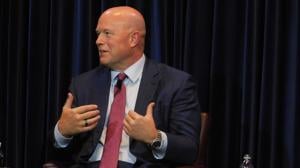
America is crucial to the defense of Greenland, which in turn is vital to protecting NATO, according to four U.S. ambassadors who expressed optimism about the Danish territory’s relationship with the U.S.
Tom Rose, the ambassador to Poland, predicted Greenland and Denmark will become more interested in President Donald Trump’s offer to buy Greenland when Trump provides a specific dollar amount.
“Let’s see what they say when the president offers them a half-trillion dollars over a 10-year period,” Rose said during a talk Wednesday evening at the Ronald Reagan Presidential Library and Museum.
He noted Greenland’s strategic importance “grows by the day, by the hour.”
Rose was joined on stage by Ambassador Matthew Whitaker, the permanent U.S. representative to NATO; Joseph Popolo, the U.S. ambassador to the Netherlands, and Nicholas Merrick, the ambassador to the Czech Republic. The ambassadors are touring the U.S. to discuss defense innovations with American technology companies, some of which are based in California.
They answered questions from David Trulio, president and CEO of the Ronald Reagan Presidential Foundation, in a packed auditorium at the library in Simi Valley, near Los Angeles. While Trulio and the ambassadors largely discussed new military technologies and innovations such as artificial intelligence in defense, they spent some time talking about Greenland, following Wednesday’s meeting at the White House between Vice President JD Vance and foreign ministers from Denmark and Greenland.
Trump has said he would prefer to buy Greenland but is willing to take it by military force, but the ambassadors Wednesday evening kept their focus on diplomatic progress.
“The president has made some straightforward, declarative statements,” Whitaker said. “Ultimately, what they all surround is the security of the western hemisphere, of the United States and how important it is to Greenland, for several reasons.”
Whitaker cited the risk of ballistic missiles flying over the Arctic region from Russia and China.
“Greenland would be the first place those would be intercepted,” Whitaker said.
He also cited the increased risks to NATO and the U.S. as the Arctic region thaws, making it easier for submarines to go by Iceland and Greenland and threaten America’s East Coast.
“The security of Greenland is the security of the United States of America and the entire North Atlantic Treaty Organization,” Whitaker said. “We need to take this very seriously and fix it sooner than later because it is going to be a problem in the coming years.”
Wednesday’s meeting at the White House was a good one for Vance and Lars Løkke Rasmussen, the Danish foreign minister, and Vivian Motzfeldt, Greenland’s minister of foreign affairs, according to Whitaker.
“Everyone was able to say their positions and talk about how we can work together to solve these challenges,” Whitaker said. He added that although no deal was reached Wednesday, diplomacy is about how differences are eventually resolved.
The ambassadors stressed the importance of an American presence in Greenland.
“There is no way Greenland, Denmark and NATO can protect Greenland alone. There has to be a solution that involves the United States. I think the president has been clear on that,” Popolo said.
The ambassador to the Netherlands noted Greenland has rare earth minerals that American companies are currently getting from China but lacks the capacity to extract them.
Rose later noted the private reaction to Trump’s proposed acquisition of Greenland differs from the public reaction.
“Privately, everybody I speak with understands and acknowledges that Denmark, as wonderful as it is, is incapable of providing even a fraction of the resources that will be required to bring Greenland up to standards in terms of its infrastructure and in terms of its ability to extract the rare earths you were speaking of earlier,” Rose said, referring to Popolo’s comments.
Earlier, Whitaker emphasized the importance of the four ambassadors’ tour of America in showcasing U.S. technology such as drones and autonomous sea vessels.
He said European countries’ commitment to spend 5% of their gross domestic product on NATO will make a difference.
“It makes a huge difference if all of our allies are strong,” Whitaker said, stressing President Ronald Reagan’s and Trump’s belief in peace through strength.
Rose noted Poland already spends 5% of its GDP on NATO and demonstrated a commitment to defense.
Likewise, “the Czech Republic has a great partner of the U.S.,” Merrick said.
He noted the nation is supplying half of the artillery shells for Ukraine’s defense against the Russian invasion and has reduced its reliance on Russian natural gas from 100% of its supply to 0.
Merrick agreed with Whitaker that in order for European countries to spend more on defense, they must grow their economies.
The ambassador to the Czech Republic said the gross domestic product for the European Union and the U.S. was the same in 2009, but today the U.S. GDP is 70% larger.
U.S. technological companies, including those based in California, are working to reduce the costs of weapon systems being sold to European countries, Merrick said.